Newsletter Pre header
ESA/Hubble/Webb weic2607: Webb redefines dividing line between planets and stars — Composition and orbit of 29 Cygni b point to accretion within a protoplanetary disc. Where is the dividing line between stars and the most massive planets? Scientists think it may depend on how they formed. Was it from a bottom-up approach, gradually growing larger over time, or a top-down approach in which a large …

Newsletter header
Newsletter header
ESA/Hubble logo ESA/Webb logo
ESA LOGO
ESA/Webb News
14 April 2026

Where is the dividing line between stars and the most massive planets? Scientists think it may depend on how they formed. Was it from a bottom-up approach, gradually growing larger over time, or a top-down approach in which a large collection of gas and dust fragments into smaller, planet-sized bits? Astronomers used the NASA/ESA/CSA James Webb Space Telescope to study an object weighing about 15 times as much as Jupiter, which puts it right on the dividing line between the two processes. They found that the object, called 29 Cygni b, likely formed from the bottom up rather than the top down. In other words, it formed like a planet, not a star.

The release, images and videos are available on:
https://esawebb.org/news/weic2607/

Kind regards,
ESA/Hubble/Webb Information Centre
14 April 2026

Newsletter Footer
Newsletter Footer
 
potm2601a   potw2552a   potw2551a   potw2550a   potw2549a  
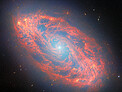
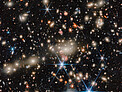
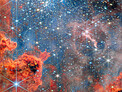
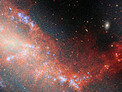
A pair of planet-forming discs   The stellar lifecycle in a nearby spiral   A celebrity cluster in the spotlight   Dwarf stars in a glittering sky   A dance of dwarf galaxies  

Follow us on:

ESA/Hubble/Webb, ESA Office, Space Telescope Science Institute, 3700 San Martin Dr, D-21218 Baltimore, United States