

The Early Universe
What did the early Universe look like? When did the first stars and galaxies emerge?
For the first time in human history we have the opportunity to directly observe the first stars and galaxies forming in the early Universe. When we observe something that is a million lightyears away, what we are seeing is actually how it looked a million years ago: we are looking back in time.
Webb’s infrared vision makes it a powerful time machine that will peer back over 13.5 billion years. Some of Hubble’s most remarkable images were its ‘deep fields’, which used long exposures – over days – to capture thousands of galaxies in single images. They revealed the most distant galaxies ever observed till then, and showed us young galaxies when they were only a few hundred million years old and were small, compact, and irregular. Webb’s infrared sensitivity looks back farther in time and reveals dramatically more information about stars and galaxies in the early Universe. Webb’s data is also answering the compelling questions of how black holes formed and grew early on, and what influence they had on the formation and evolution of the early Universe.
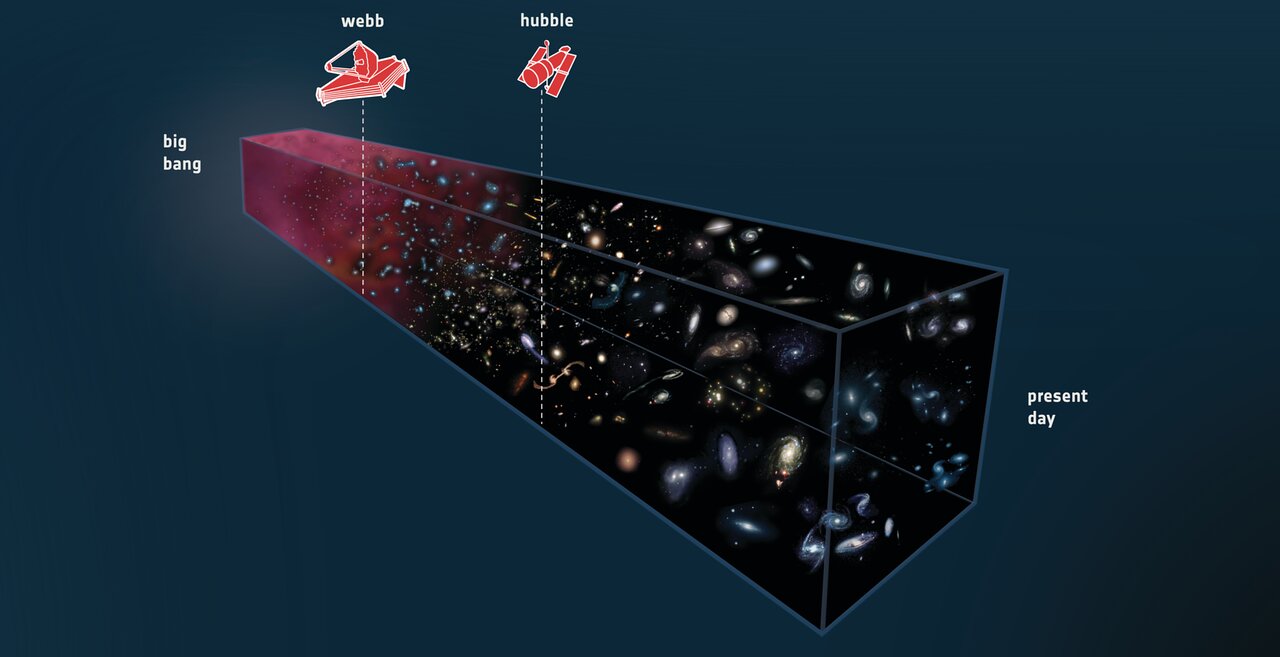
Webb is actively exploring the early Universe and how galaxies evolved over time. Operating as a powerful time machine that peers back over 13.5 billion years, Webb is pushing beyond Hubble’s limits by looking back even farther and observing the first stars and galaxies forming.