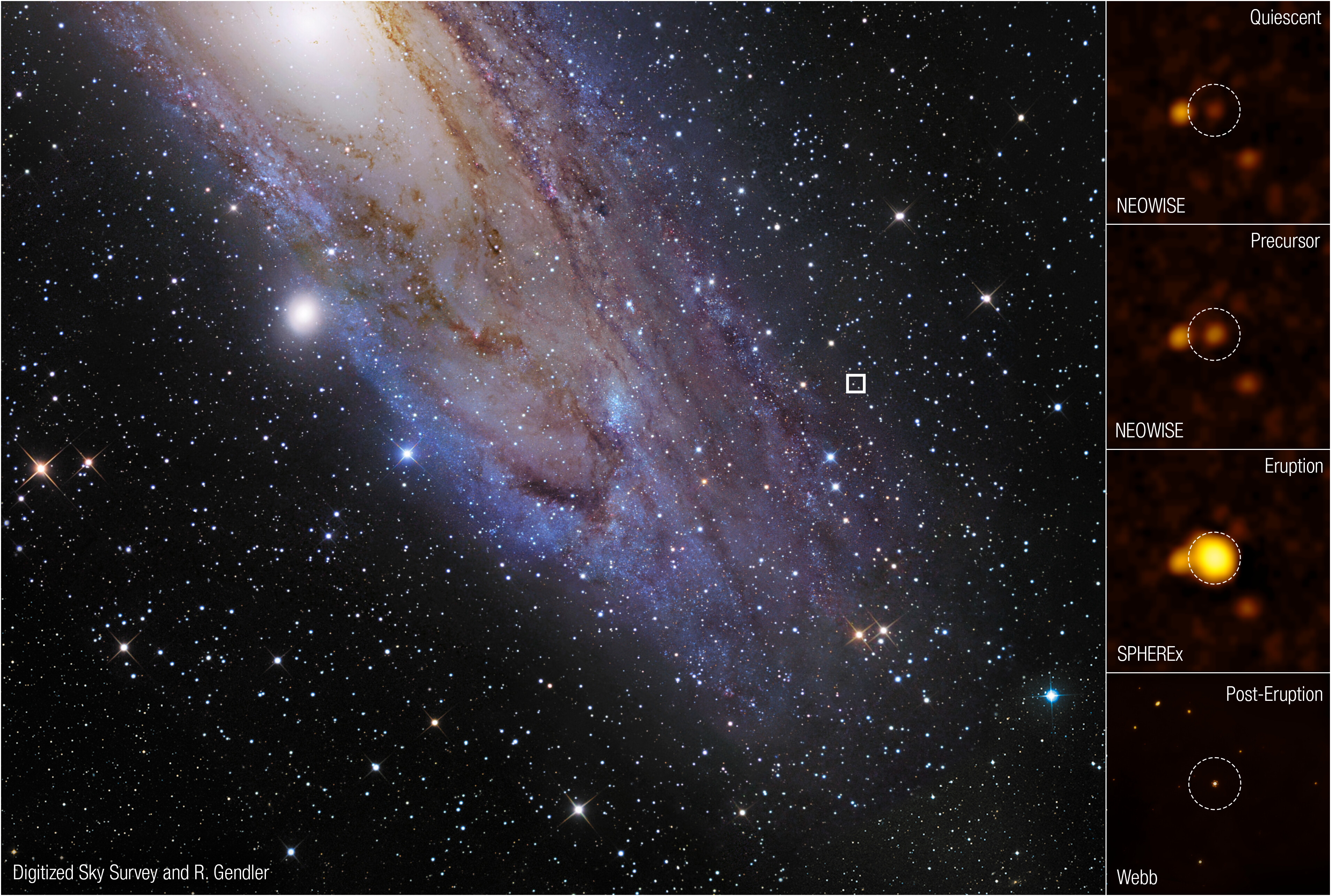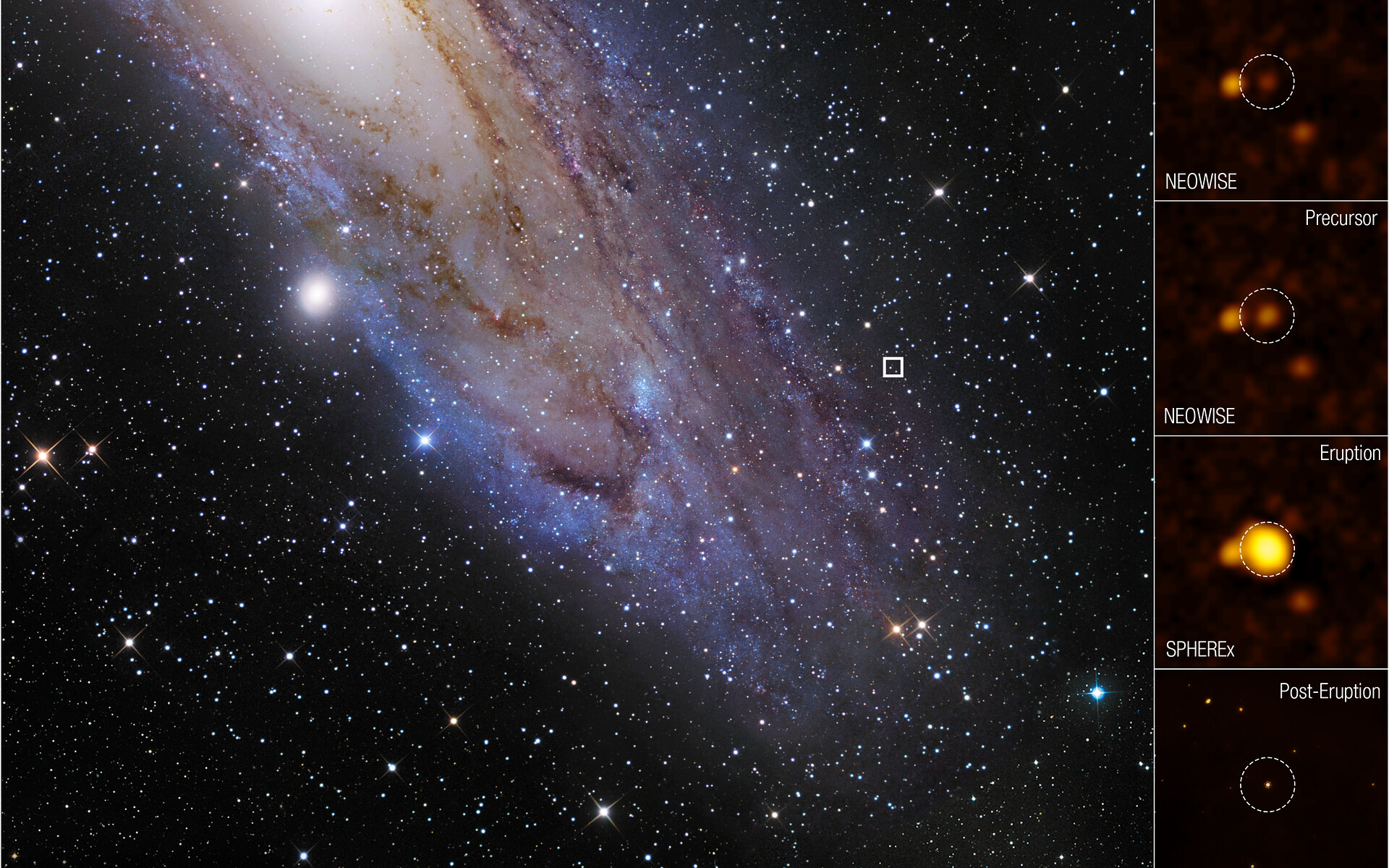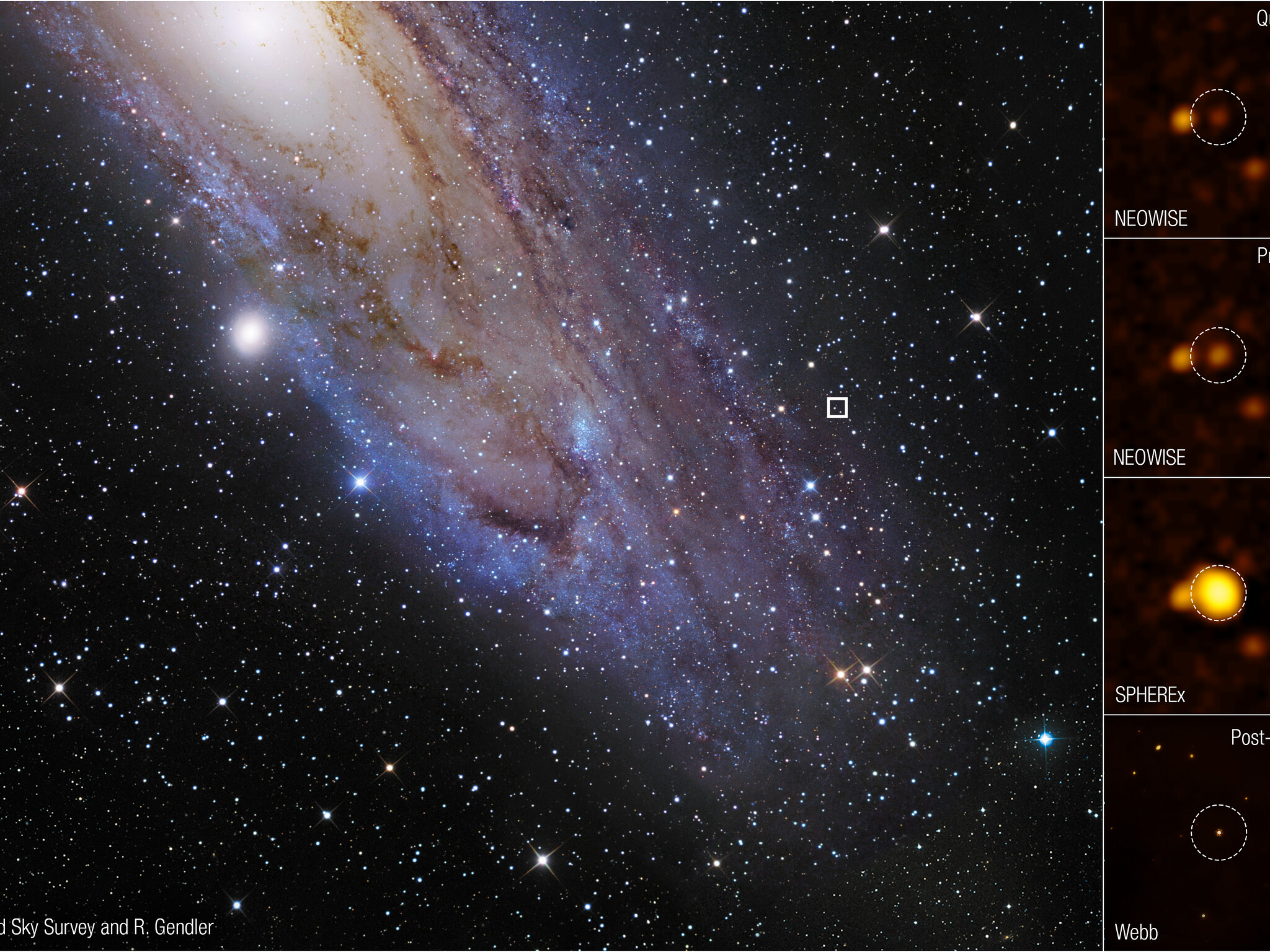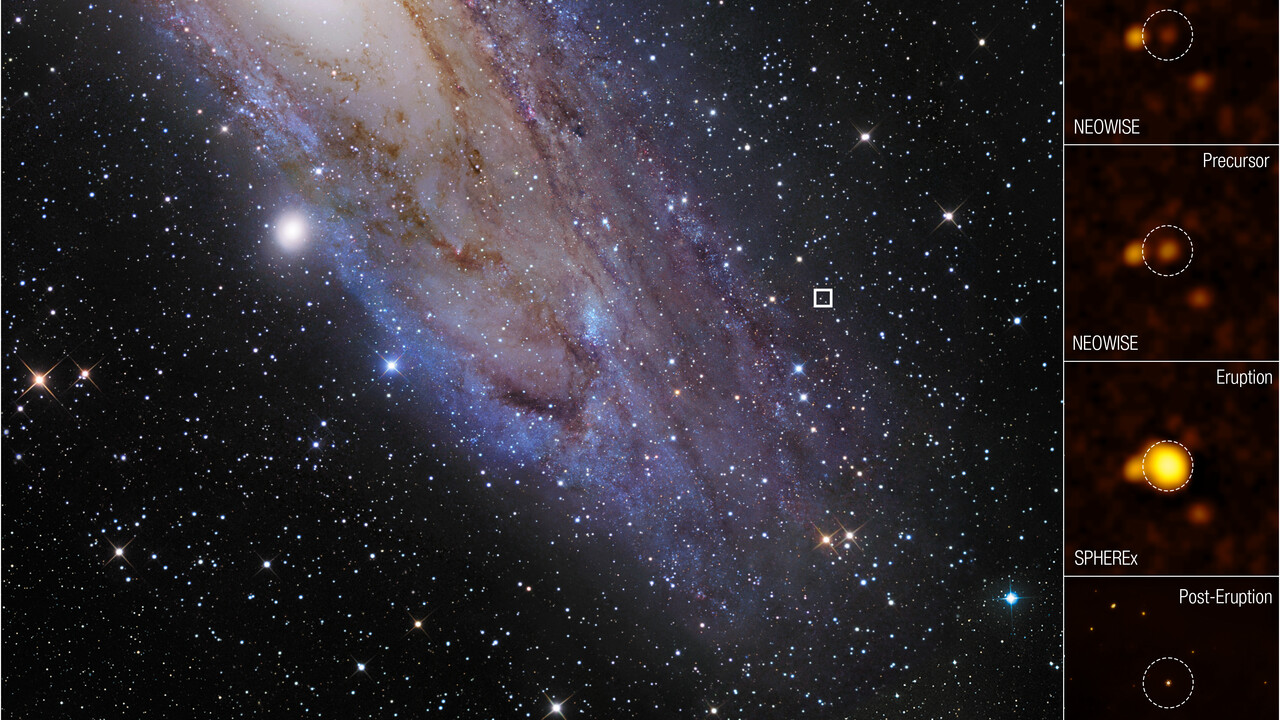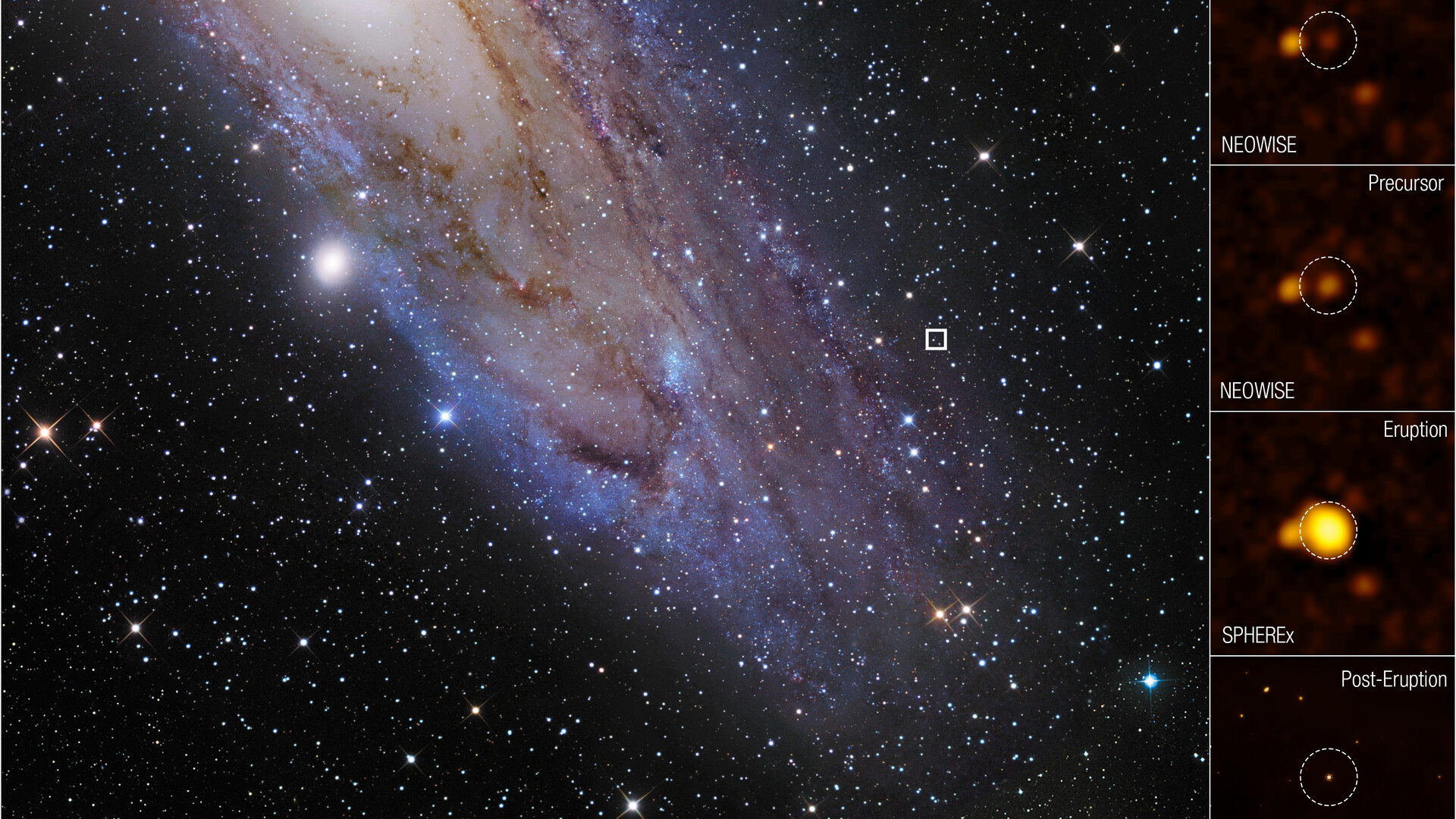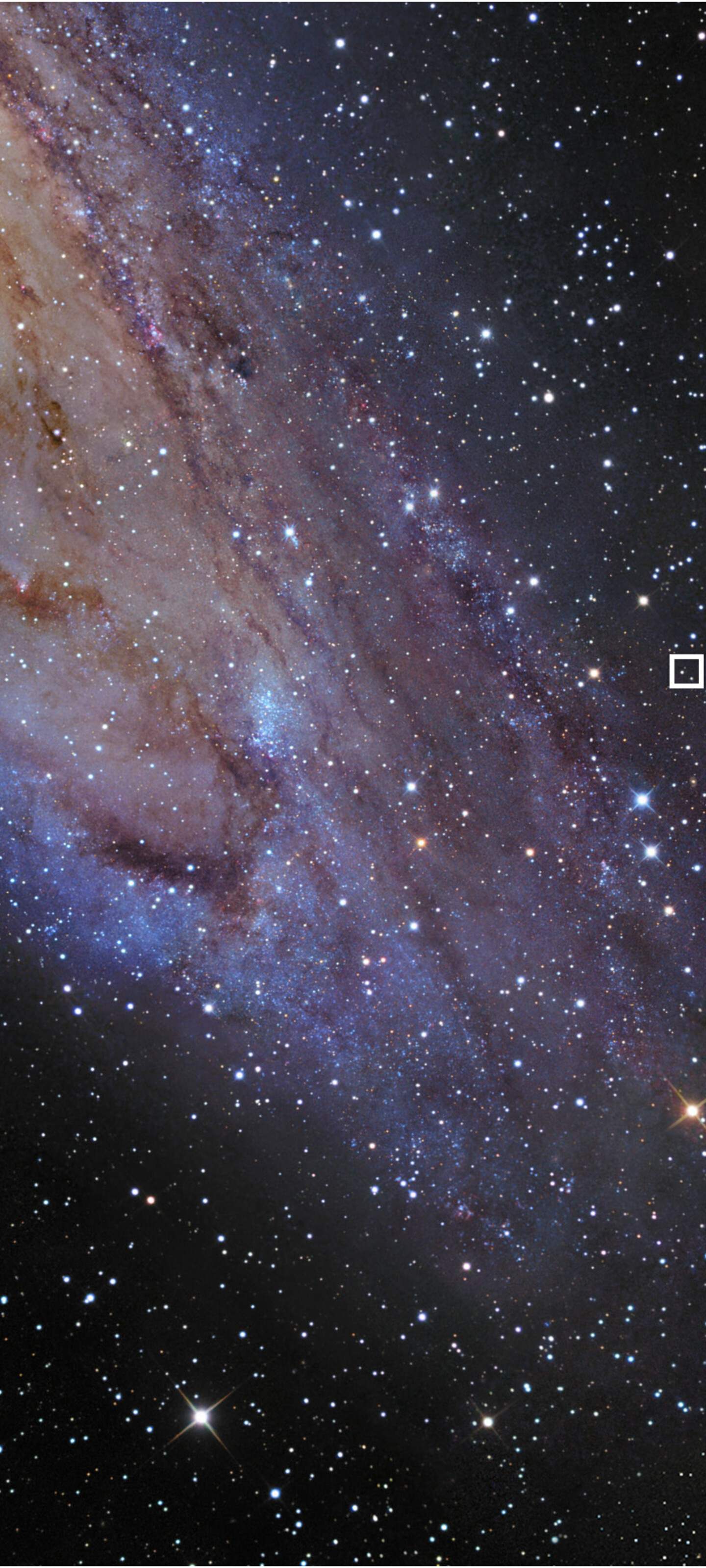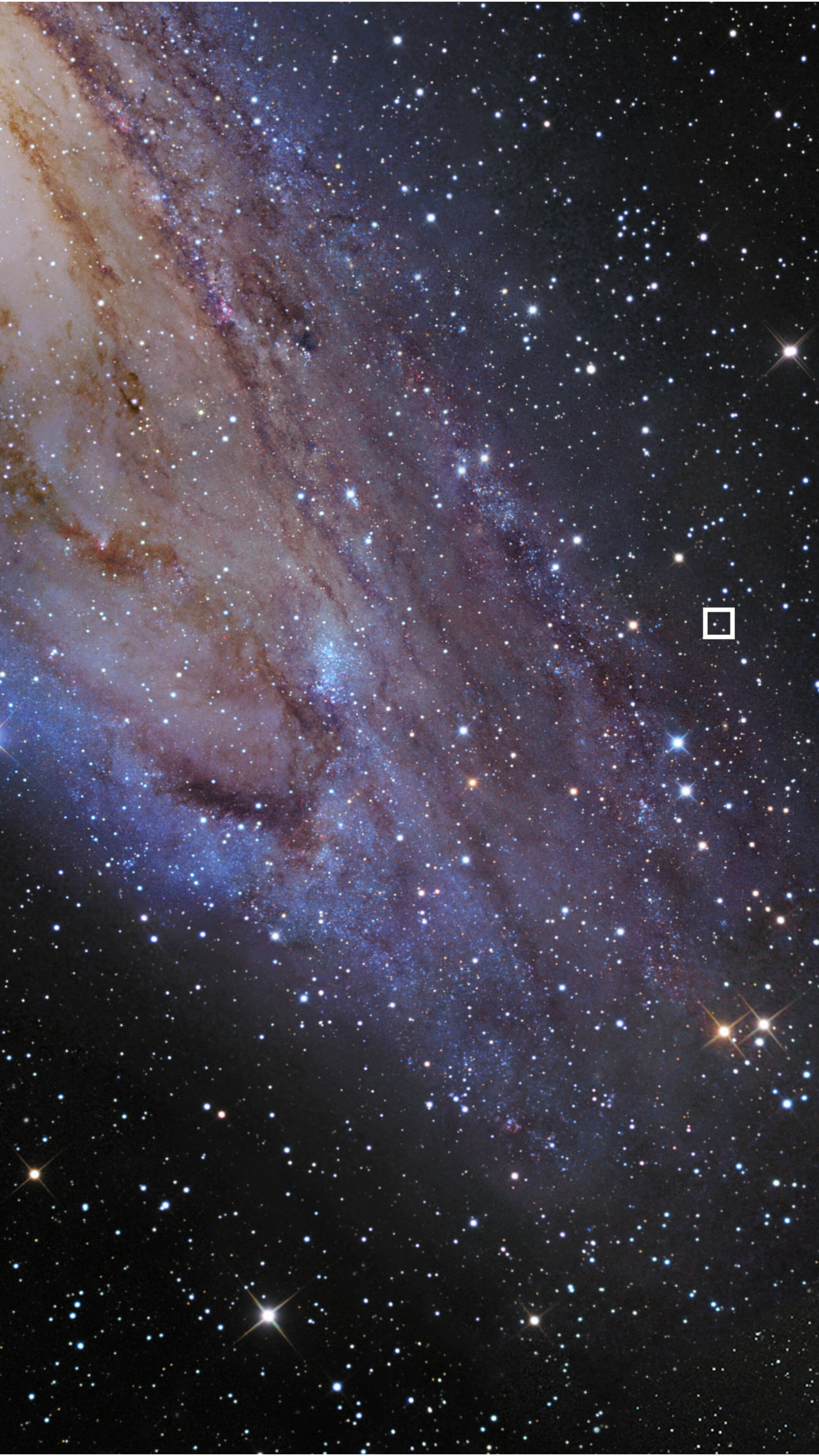
AT 2025abao in the Andromeda Galaxy
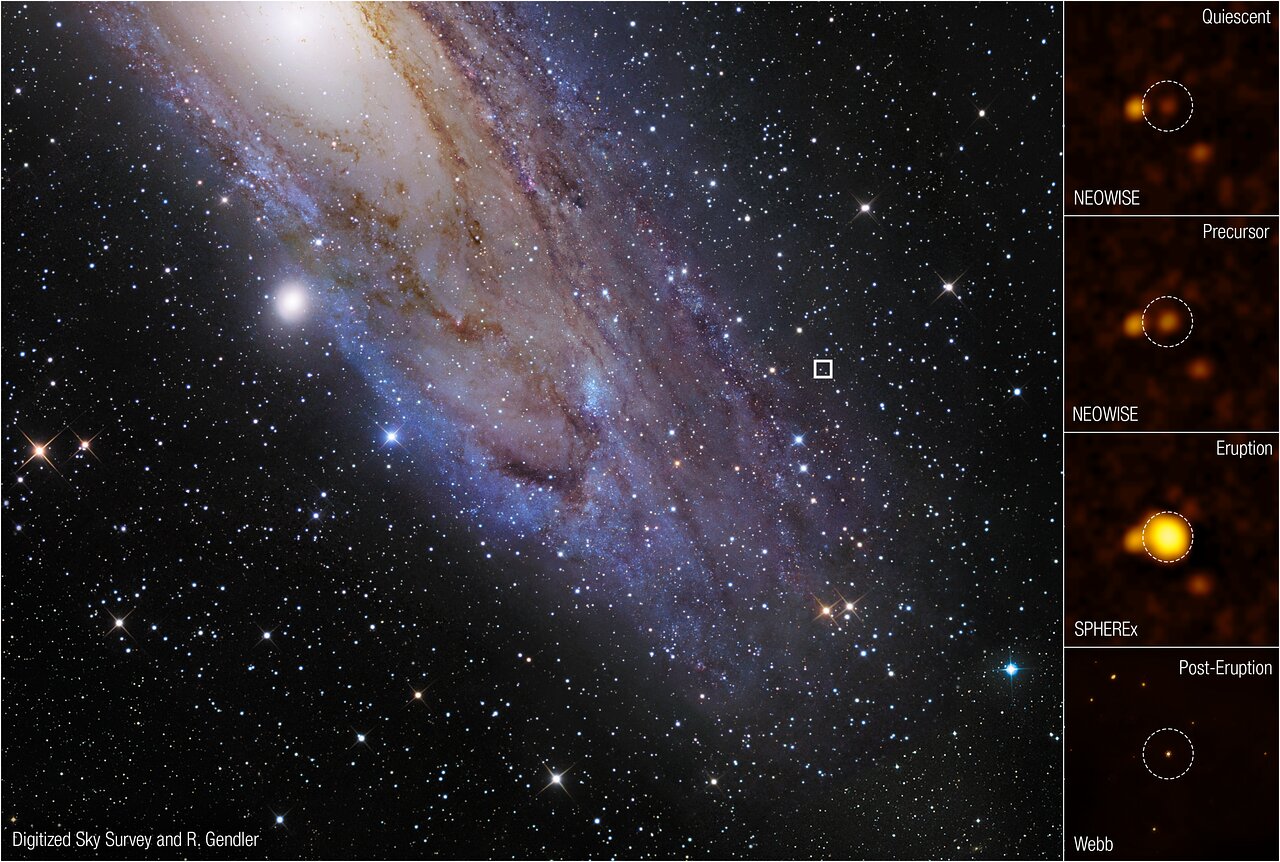
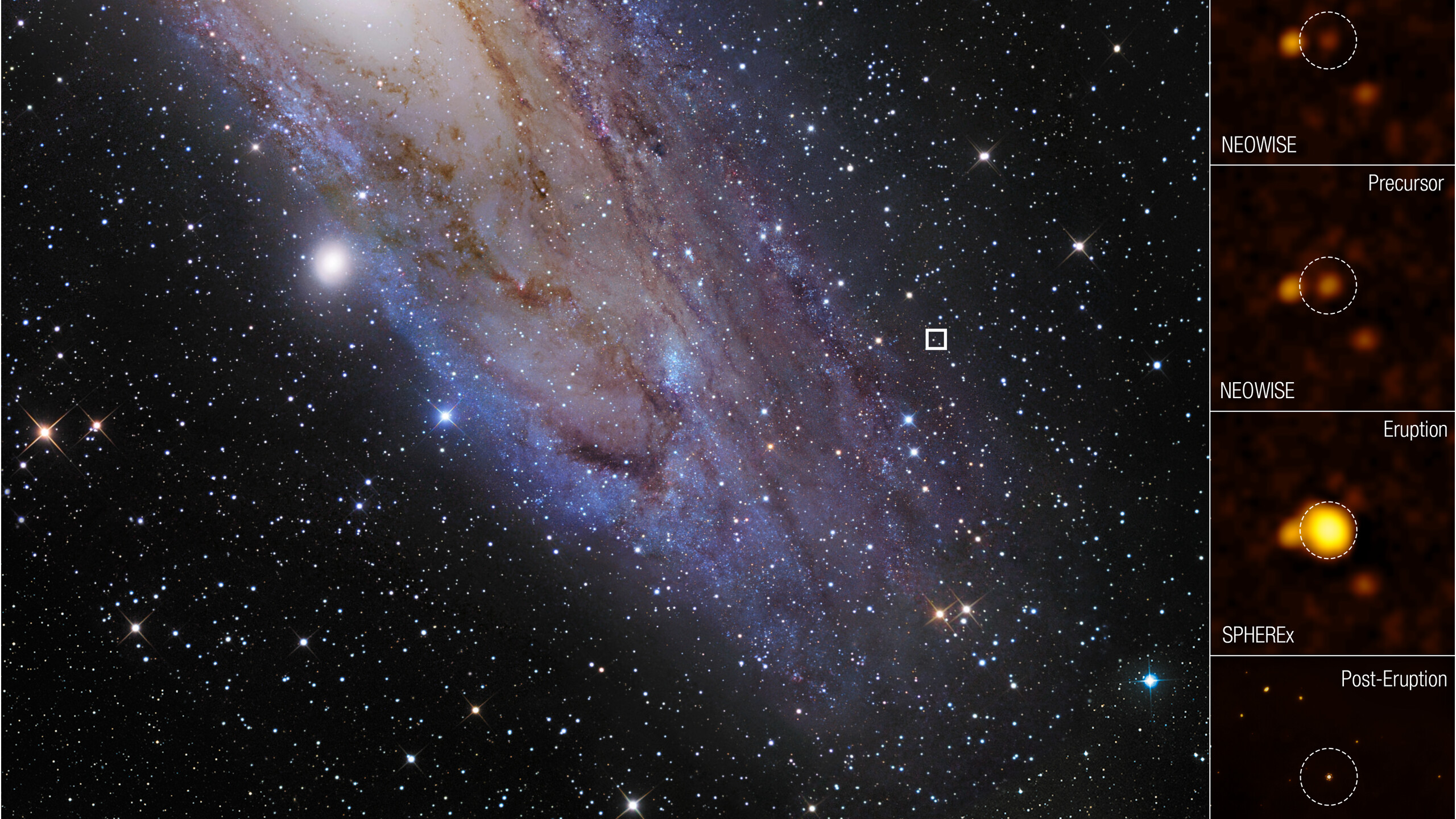
In December 2025, observations from the NASA/ESA/CSA James Webb Space Telescope provided key evidence that allowed researchers to fully reconstruct what happened before, during, and after the merger of a binary star system nicknamed Bao at the edge of the Andromeda galaxy.
Taken in only three hours as part of a Director’s Discretionary Time program on 24 December 2025, Webb’s mid-infrared-light data allowed researchers to trace dust ejected by the primary star over centuries — including almost two months after the merger. Once they matched Webb’s data to the output of their sophisticated simulations of the stellar system, they proved that the stars merged, marking the first time astronomers have used telescope data to directly measure the efficiency of common envelope evolution.
Although Webb’s data provided the exhilarating conclusion, the team had followed Bao’s saga closely since February 2023, when they saw an unusual variable star in NASA’s NEOWISE mid-infrared data. By referencing other telescopes’ observations, they found Bao had a consistent luminosity from 1989 to 2018 when it began to brighten.
In September 2024, near-infrared data taken by the Wide-field Infrared Transient Explorer (WINTER) showed that Bao was not only beginning to brighten — but also spew dust. During a routine survey in July 2025, NASA’s SPHEREx mission serendipitously saw Bao fade rapidly in visible light and begin to rise in near-infrared light.
Events truly kicked off when the Zwicky Transient Facility detected the eruption in visible light on 17 October 2025 — showing that the stars rapidly brightened and radically heated up. The ground-based Himalayan Chandra Telescope in India followed up, capturing visible-light spectra later that month. In November, the team also received multiple fast-turn ultraviolet-light observations from NASA’s Neil Gehrels Swift Observatory.
On 24 December 2025, Webb observed Bao, detailing all the dust around it. The team observed the source with Spain’s Gran Telescopio CANARIAS on the Canary Islands twice, both a day later and in January 2026. A series of visible-light observations from NOIRLab’s Gemini North telescope in Hawaii rolled in from November 2025 through February 2026. They also cross-referenced infrared spectra taken before the stars’ eruption on September 8 by NASA's Infrared Telescope Facility and afterward on December 24, which coincided with Webb’s observations. They found that Bao’s brightness plateaued from November and December, and it slowly cooled to roughly its initial temperature.
In total, the data the team referenced included ultraviolet, visible, near-infrared, and mid-infrared light observations — a significant portion of the electromagnetic spectrum.
Learn more about this discovery here.
Credit:Image: NASA, ESA, CSA, STScI, V. Karambelkar (Columbia), K. De (Columbia). Image Processing: A. Pagan (STScI)
Acknowledgment: R. Gendler, DSS
About the Image
| Id: | AT2025abao | |
|---|---|---|
| Type: | Collage | |
| Release date: | 18 November 2026, 17:00 | |
| Size: | 3819 x 2571 px | |