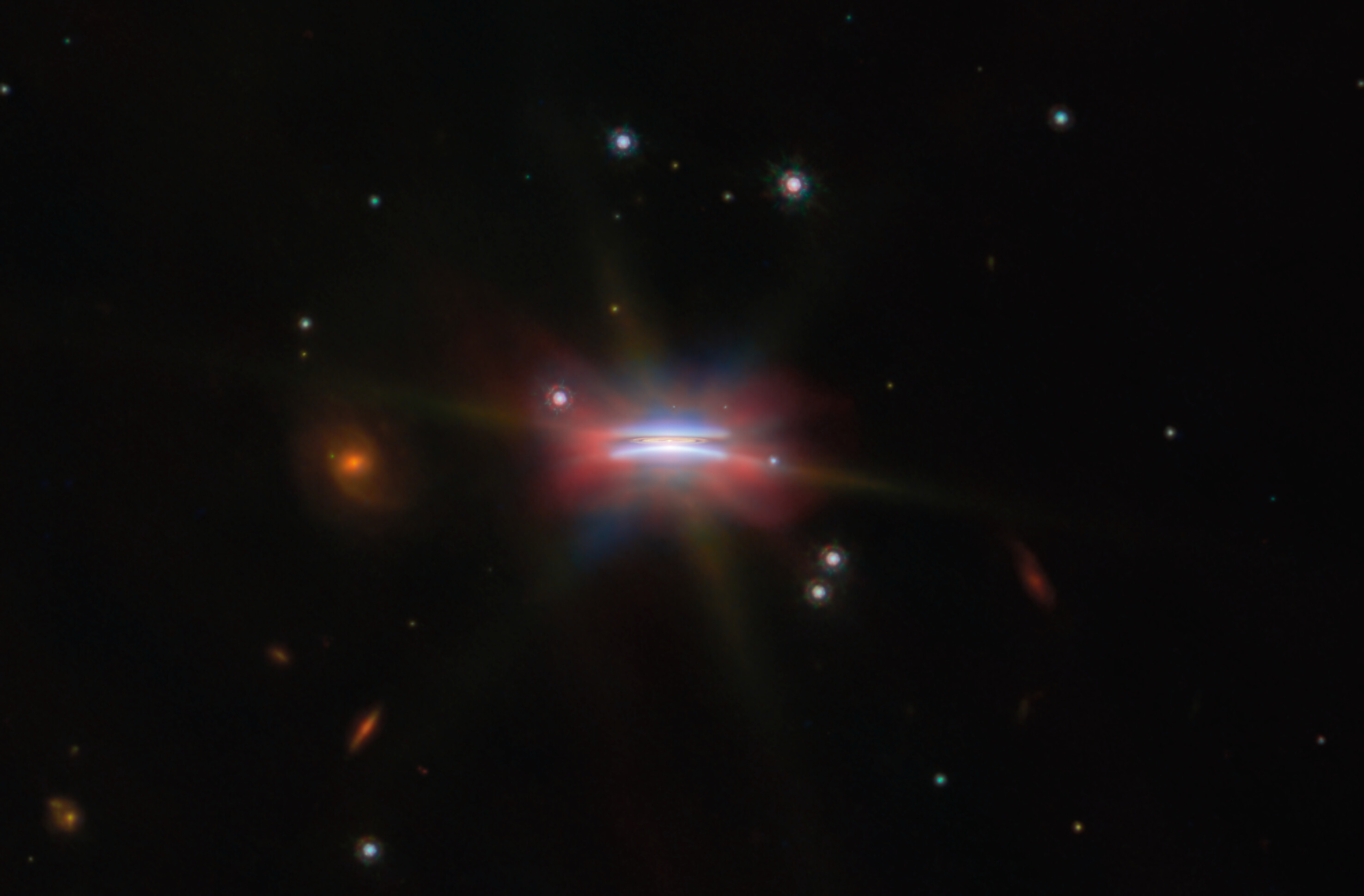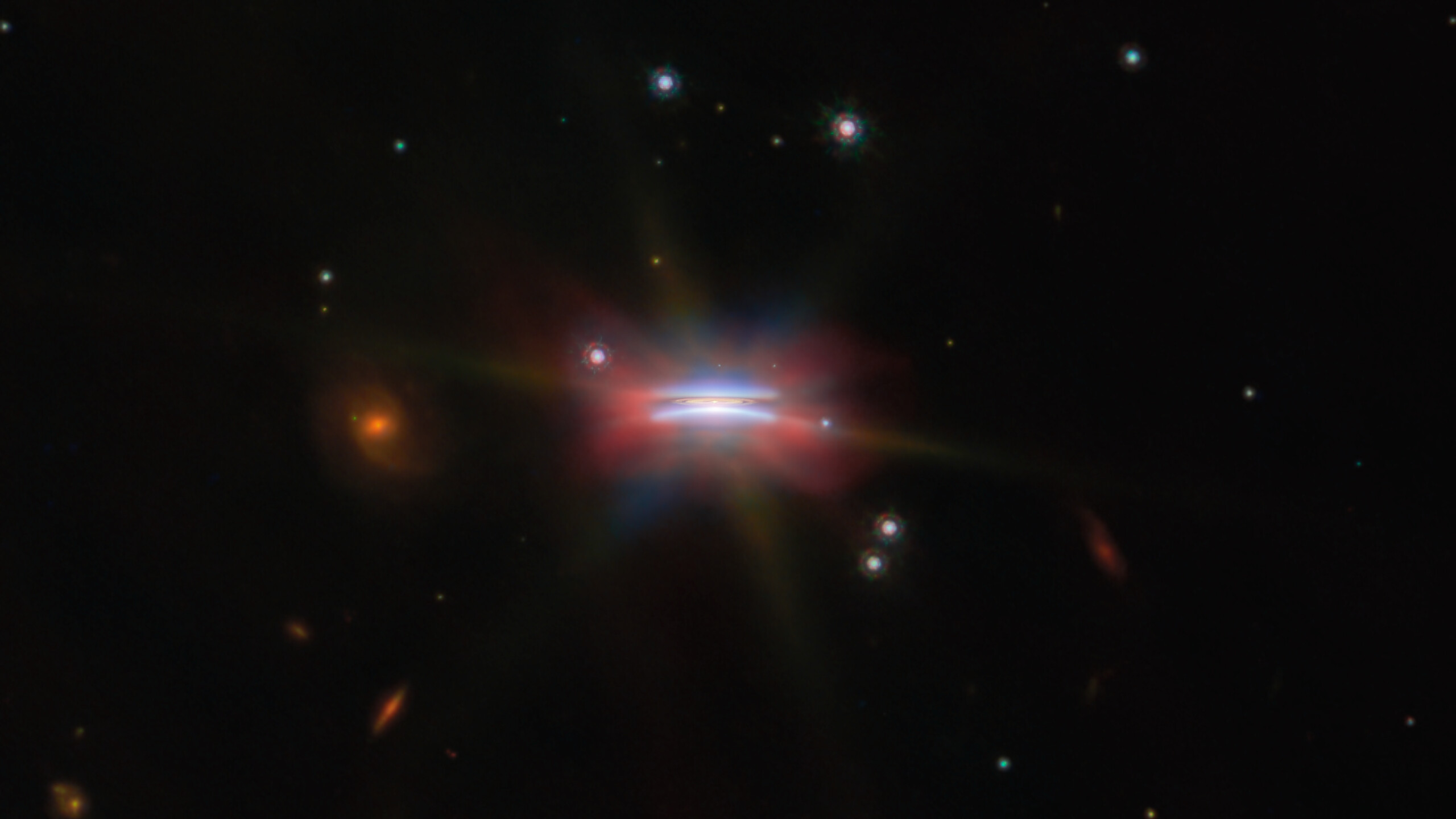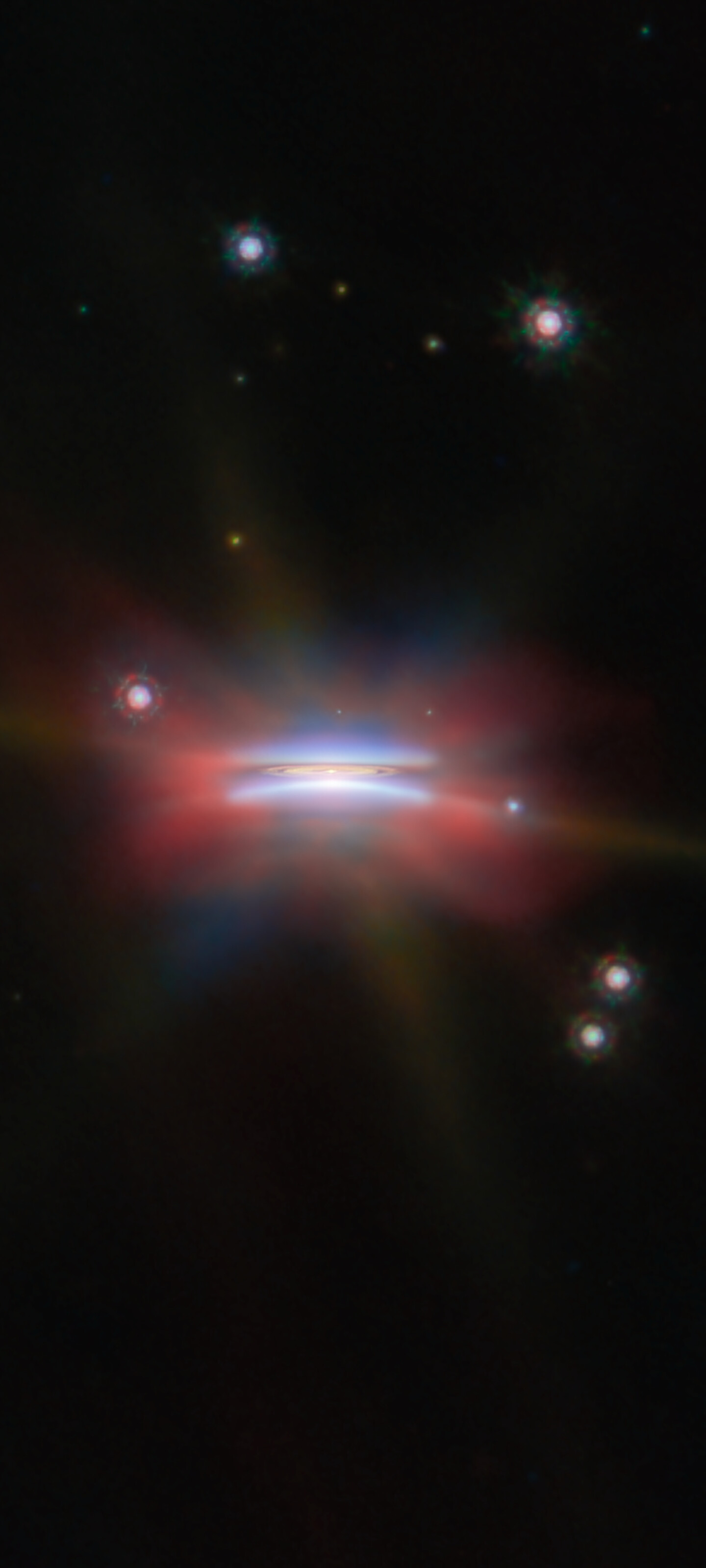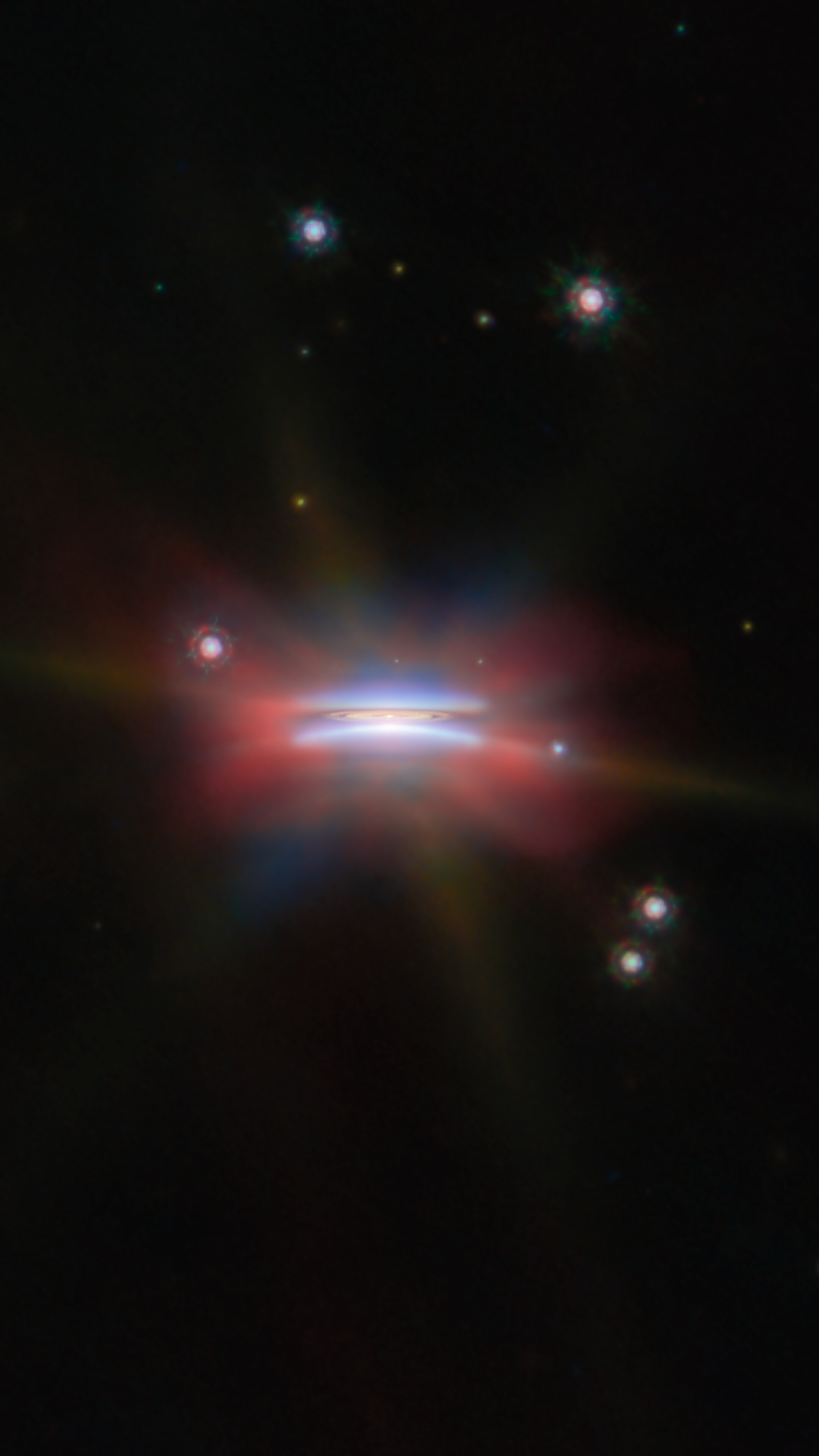

Oph 163131 (wide view)
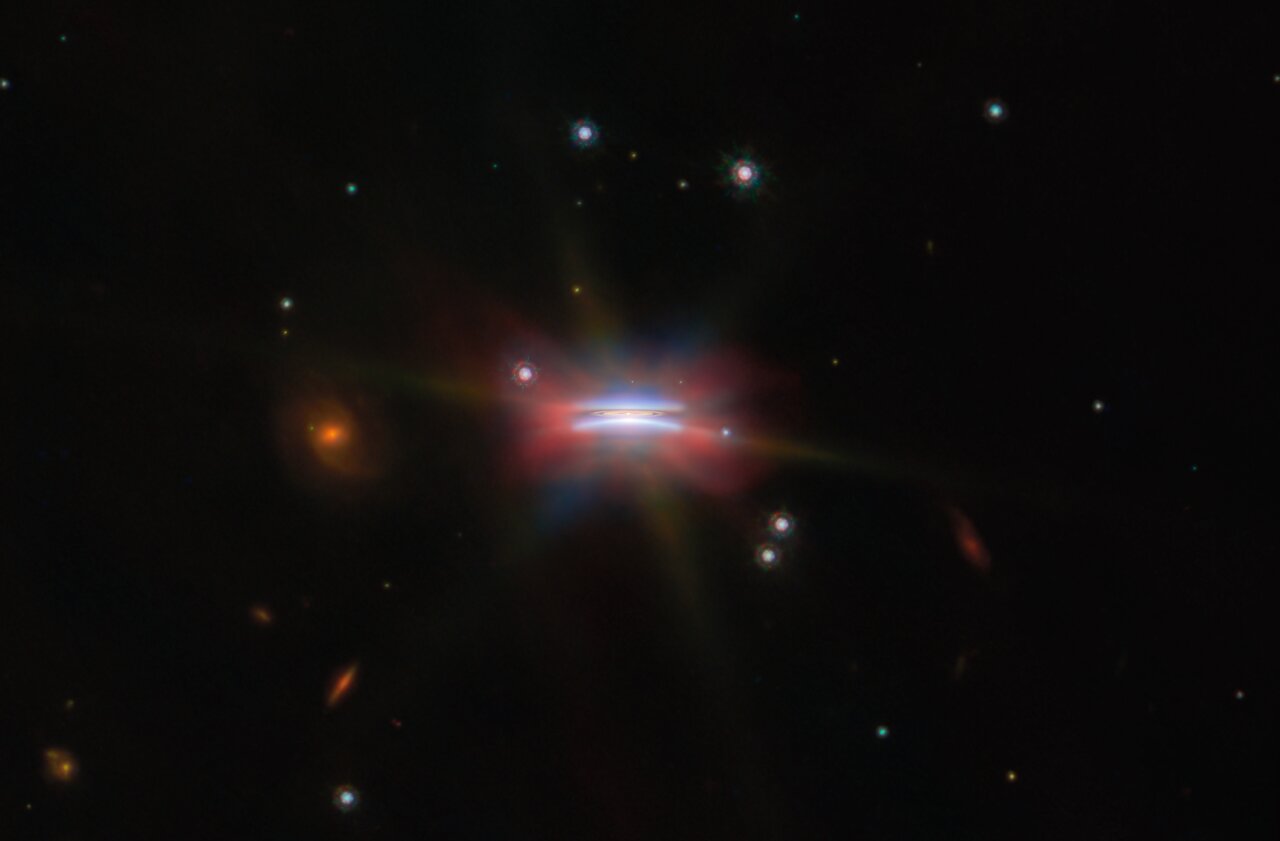
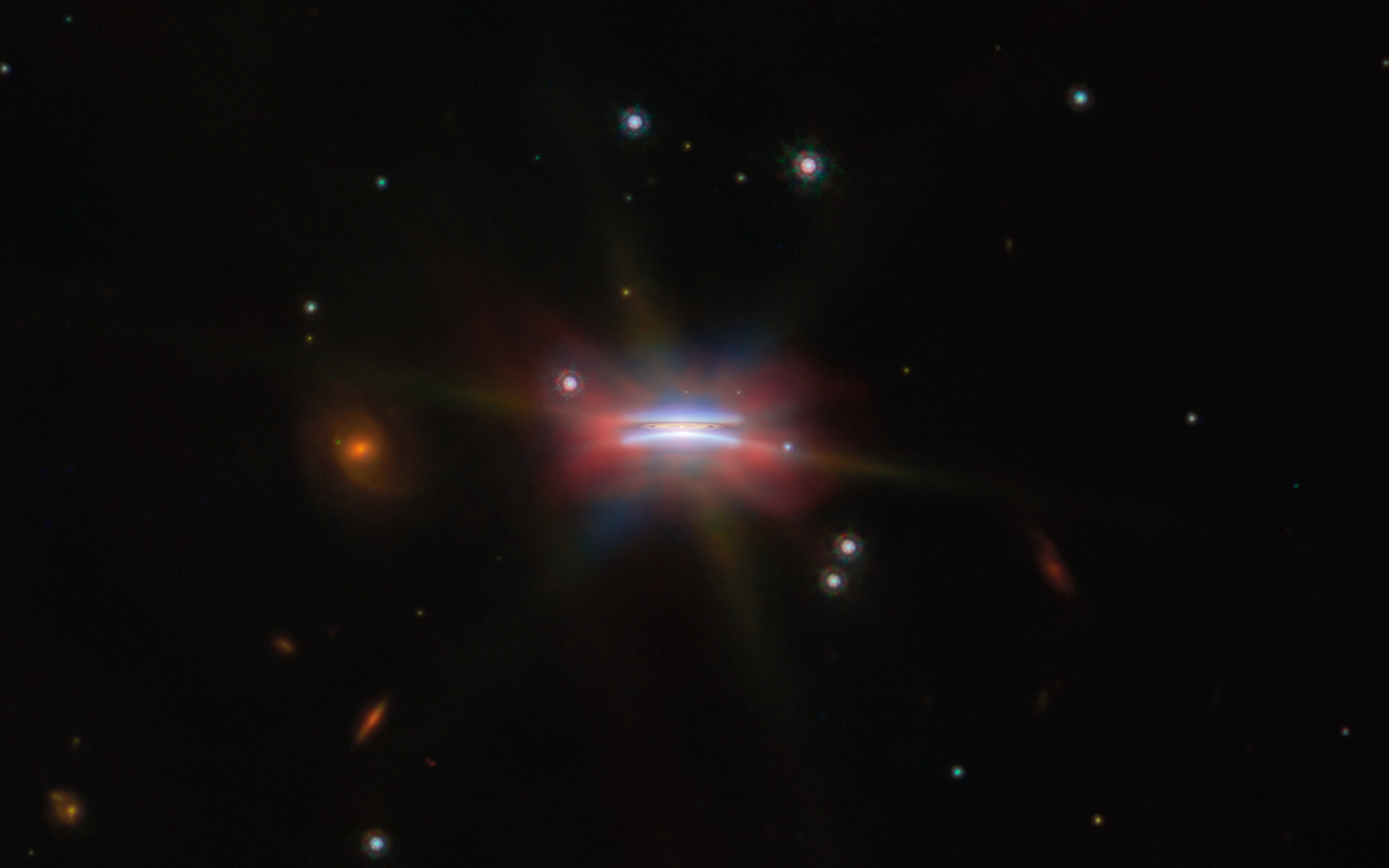
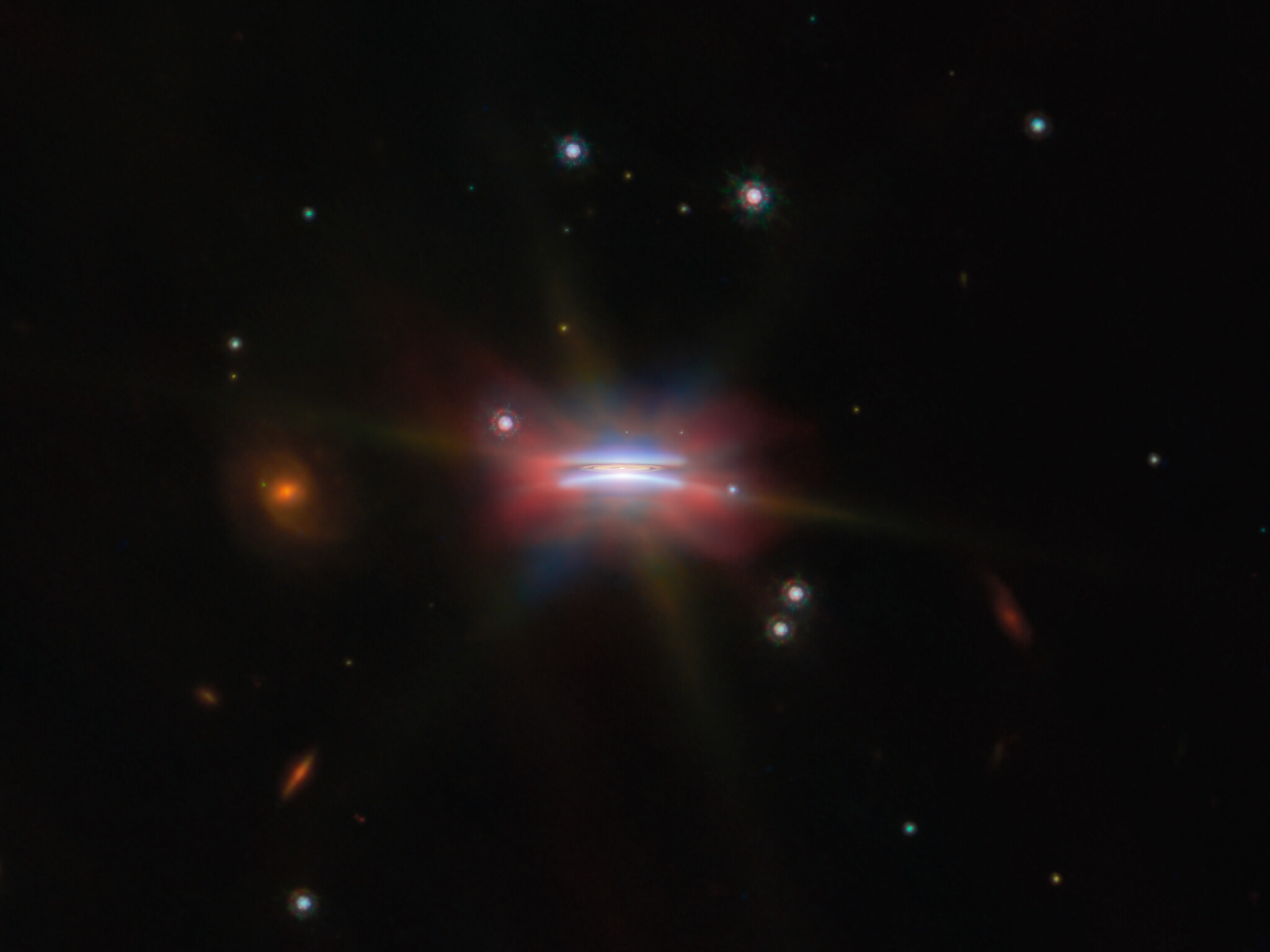
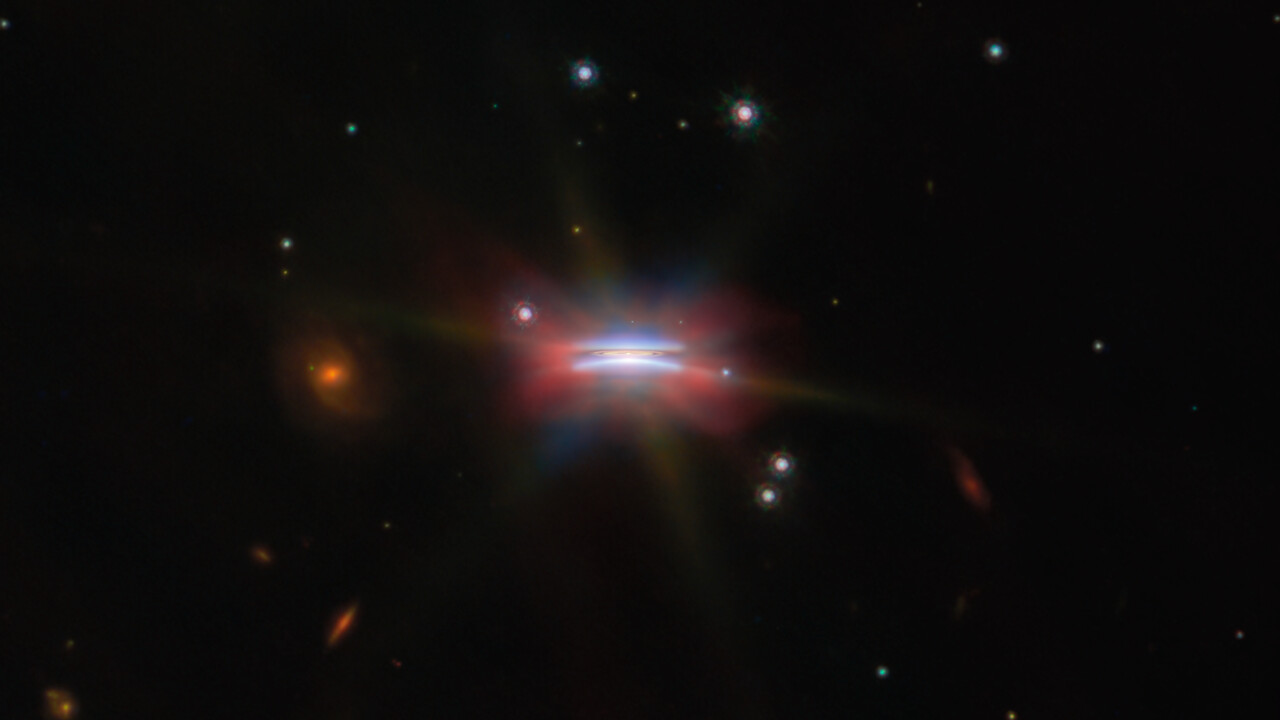
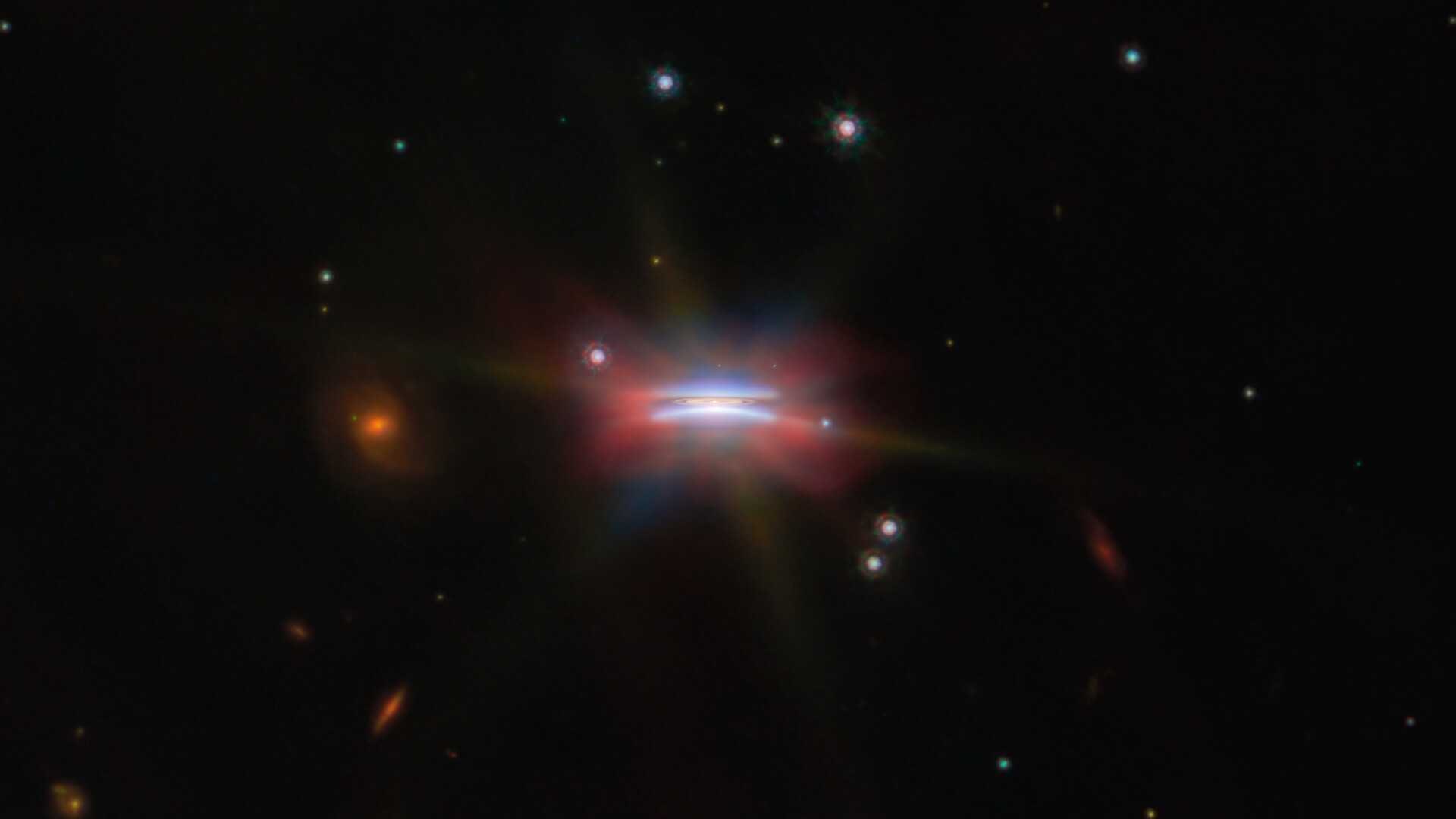
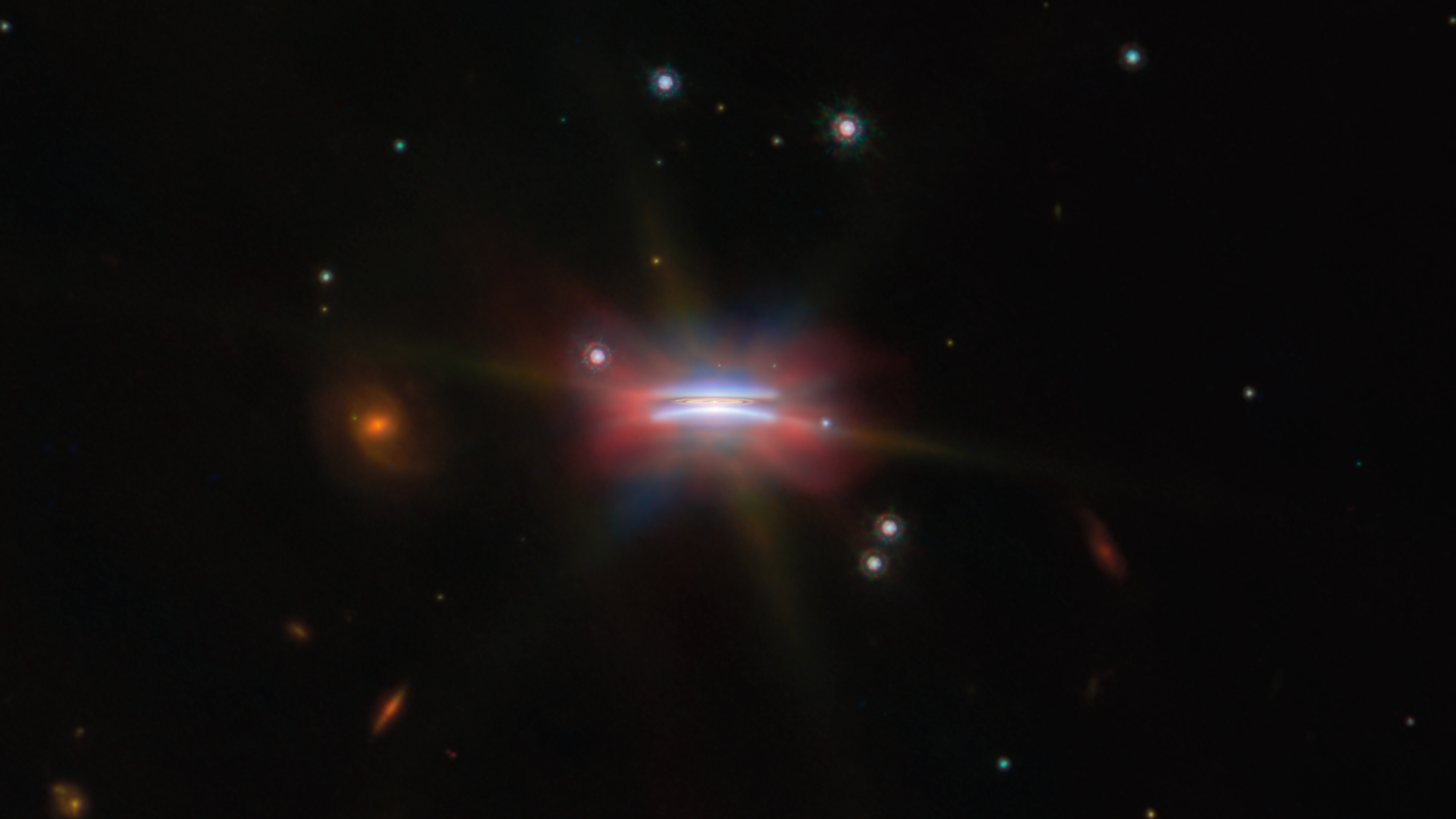
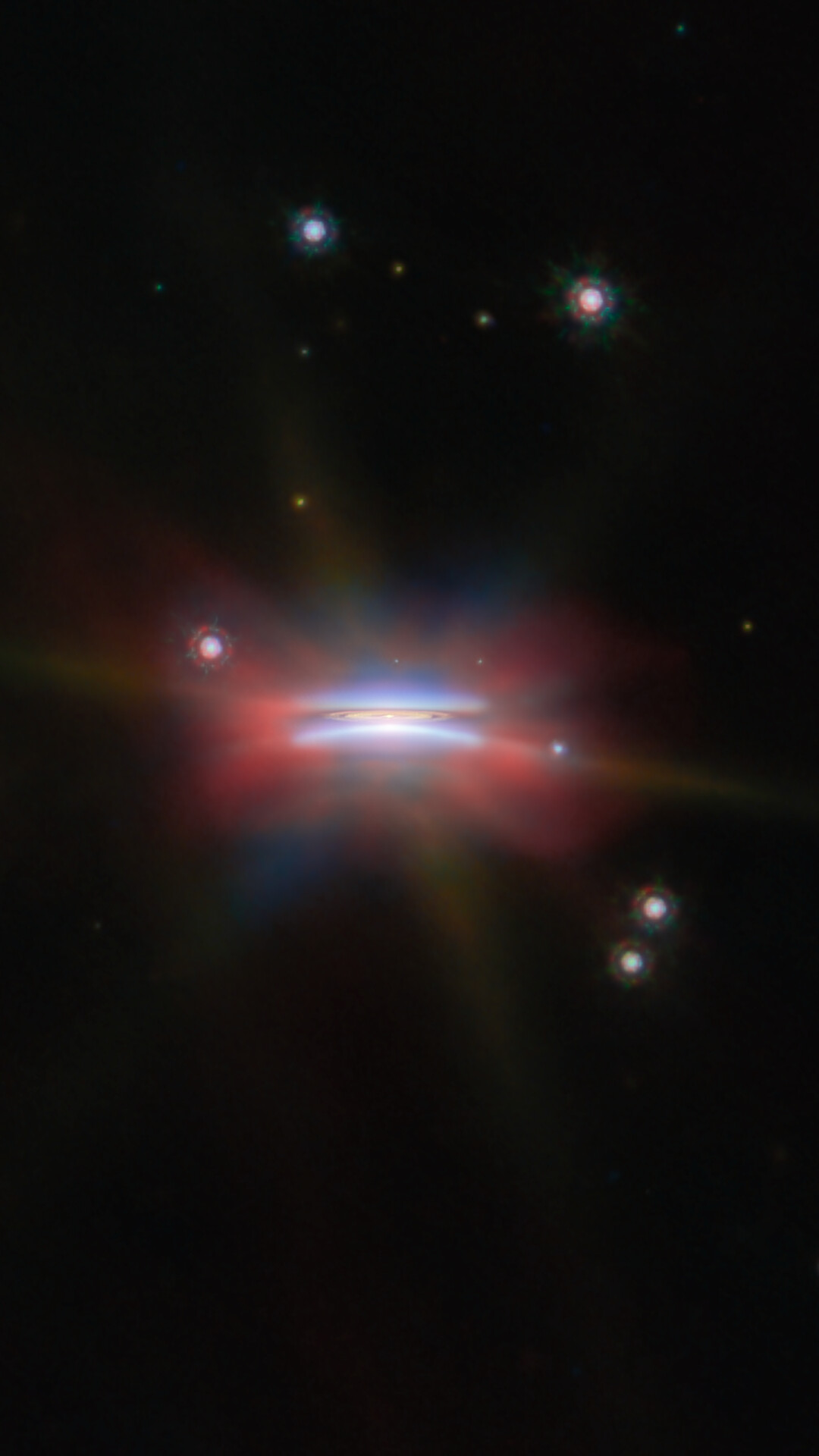
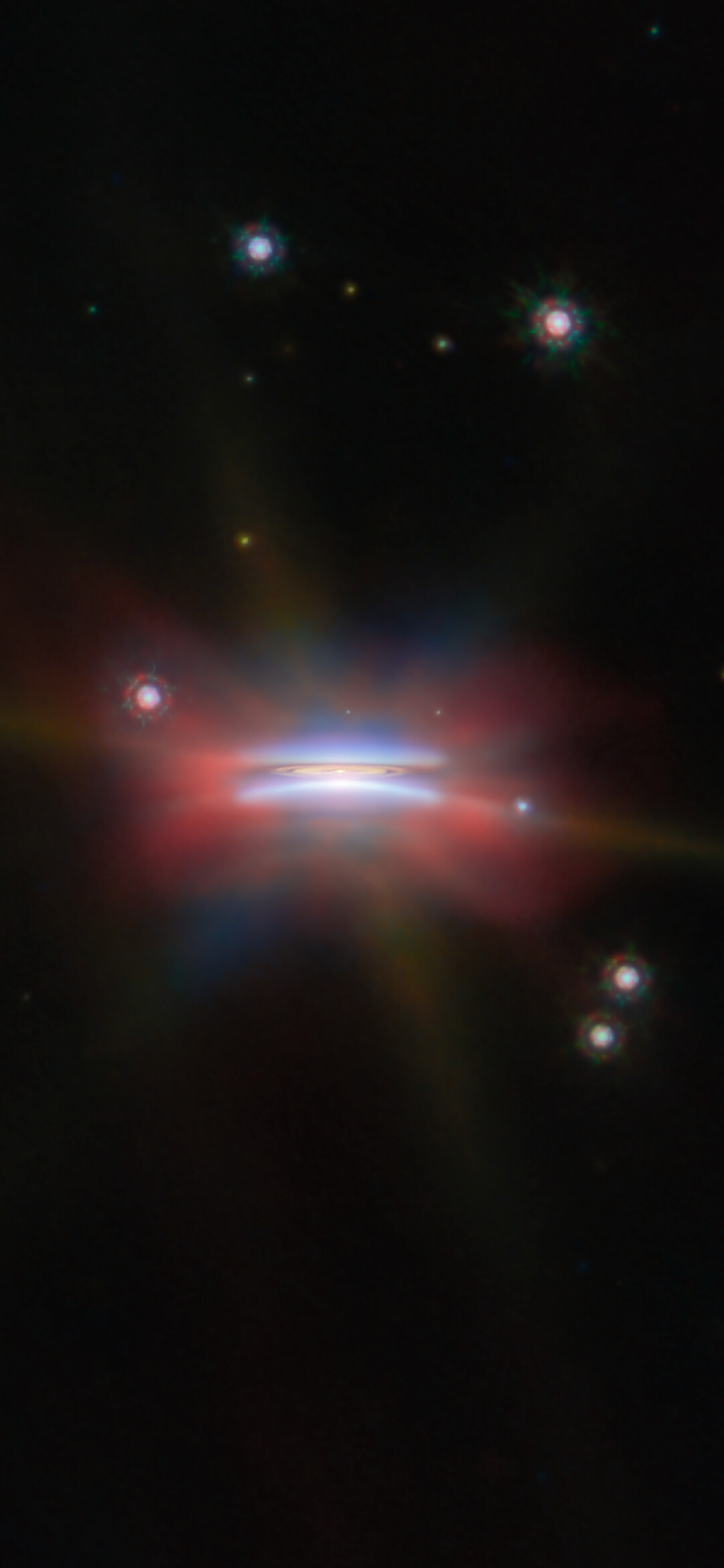
This shining disc in the middle of a dark, empty background is a protoplanetary disc named Oph 163131, and it’s one of two featured for this month's ESA/Webb Picture of the Month. Also catalogued as 2MASS J16313124-2426281, it is located about 480 light-years away in our galaxy, in the constellation Ophiuchus. Its close location, almost edge-on inclination of 85 degrees (where 90 would be perfectly edge-on) and its considerable size of 66 billion kilometres across — several times wider than our Solar System — make it an excellent target for studying these kinds of planet-forming discs.
At the centre of Oph 163131 is a newly formed star that’s still wrapped in a thick disc of gas and dust. Eventually the new star will disperse all the dust with its ferocious radiation, but before that happens there’s a chance for the dust to clump together and grow into pebbles, planetesimals and eventually planets — hence, a protoplanetary disc. Whether planets appear, and what kind of planets they are, depends on how larger and smaller dust grains migrate in the disc. An edge-on view like this shows us if dust grains are settling into a layer of large dust grains at the core of the disc. Such a layer is critical for dust grains to further grow and begin forming planets, and the thicker it is, the better.
This image of Oph 163131 combines near- and mid-infrared data from Webb’s NIRCam and MIRI instruments with visible light captured by the NASA/ESA Hubble Space Telescope and radio waves from the Atacama Large Millimeter/submillimeter Array (ALMA). Where Hubble and Webb each image tiny dust grains only micrometres across, ALMA sees larger dust grains that are about a milimetre in size, which are concentrated in the central plane of the disc. Combined with the very slightly off-edge perspective, this creates a particularly clear picture of the structure of Oph 163131.
Small dust grains floating above and below the disc scatter light from the star and reflect it at us, creating the purple arcs above and below the centre; these are most clearly seen by Hubble and Webb’s NIRCam. The disc of dust itself, here shown in yellow, is made of the larger dust grains visible to ALMA. It distinctly shows two rings separated by a gap — potentially a region where a planet is already forming and clearing up dust in the disc. The red, green and blue glow around the disc that extends far into the background appears most brightly in the mid-infrared images from MIRI, combined with the distinctive diffraction spikes from Webb at the longer wavelength observations.
Taken together, the observations describe a disc where the large dust grains that create an environment where planets can form have been concentrated into the centre, and might even have created a clump of gas that is well on its way to becoming a new planet. We get a unique view of this very interesting protoplanetary disc out of the bargain, too!
[Image Description: A protoplanetary disc around a newly-formed star. The disc itself appears to be made of two flat, purple lobes that meet in the centre. Yellow rings are visible in the midplane. The whole disc glows brightly, shining bands of green, blue and red light into space around it. Several stars are visible nearby as white dots. Distant galaxies also appear as large, dark orange spirals and other shapes, fading into the black background.]
Links
- Oph 163131 and Tau 042021 side by side
- Annotated close-up of Oph 163131
- Image of Tau 042021
- Image on ESA website
ESA/Webb, NASA & CSA, ESA/Hubble, ALMA (ESO/NAOJ/NRAO), M. Villenave
About the Image
| Id: | potm2603b | |
|---|---|---|
| Type: | Observation | |
| Release date: | 3 April 2026, 10:00 | |
| Size: | 2952 x 1940 px | |