
About the Object
| Distance: |
161000 light years | |
|---|---|---|
| Constellation: | Dorado | |
| Category: | Nebulae NIRCam Picture of the Month | |
Coordinates
| Position (RA): | 5 39 52.94 |
|---|---|
| Position (Dec): | -69° 45' 16.45" |
| Field of view: | 5.04 x 3.36 arcminutes |
| Orientation: | North is 24.4° left of vertical |

Interactive Sky View
Background Survey Options
Colours & filters
| Band | Wavelength | Telescope |
|---|---|---|
| Infrared (Blue) | 1.4 μm | James Webb Space Telescope NIRCam |
| Infrared (Blue) | 1.15 μm | James Webb Space Telescope NIRCam |
|
Infrared
(Cyan) P-alpha | 1.87 μm | James Webb Space Telescope NIRCam |
|
Infrared
(Cyan) methane | 2.1 μm | James Webb Space Telescope NIRCam |
| Infrared (Green) | 3.0 μm | James Webb Space Telescope NIRCam |
|
Infrared
(Green) molecular hydrogen | 2.12 μm | James Webb Space Telescope NIRCam |
| Infrared (Orange) | 3.6 μm | James Webb Space Telescope NIRCam |
|
Infrared
(Orange) PAH | 3.35 μm | James Webb Space Telescope NIRCam |
|
Infrared
(Red) CO | 4.6 μm | James Webb Space Telescope NIRCam |
|
Infrared
(Red) molecular hydrogen | 4.7 μm | James Webb Space Telescope NIRCam |
Stars brewing in a nebulous cauldron
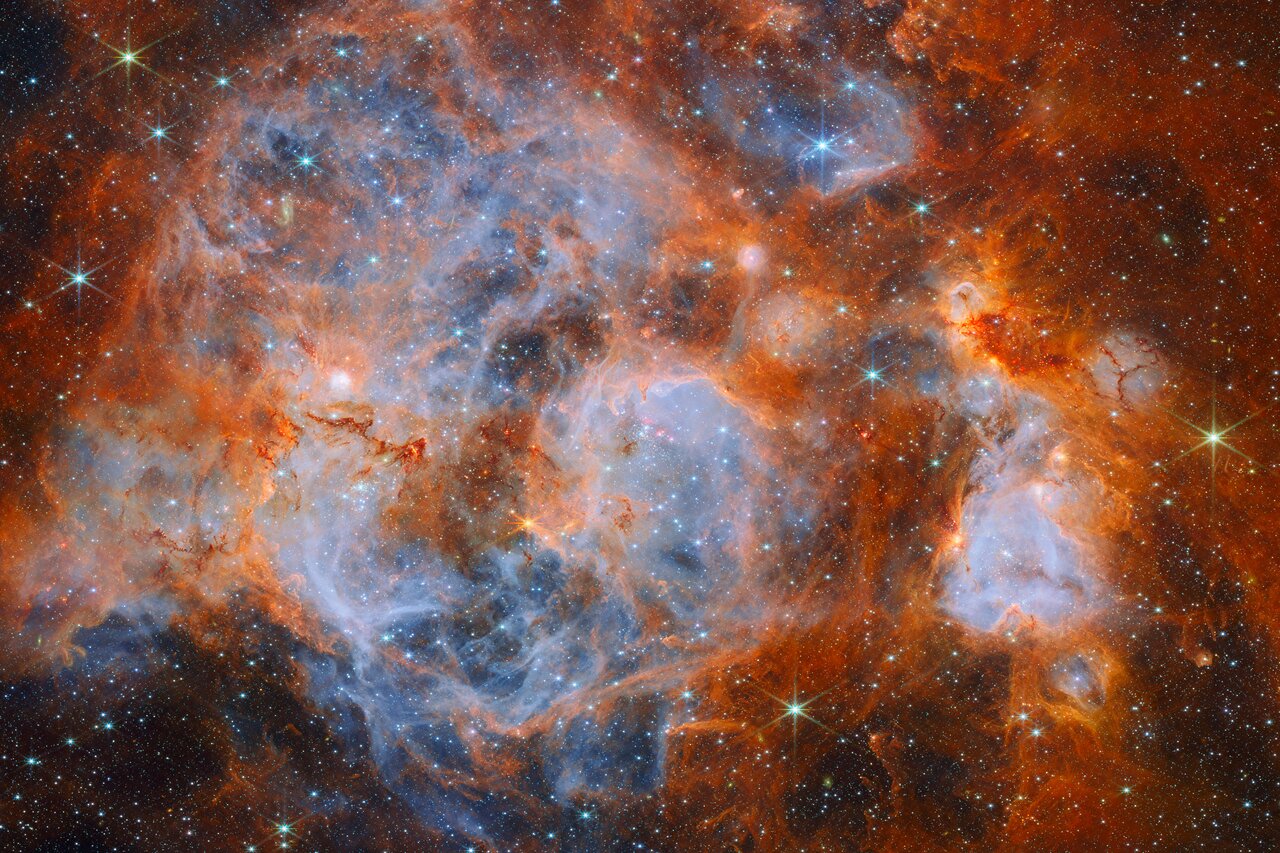
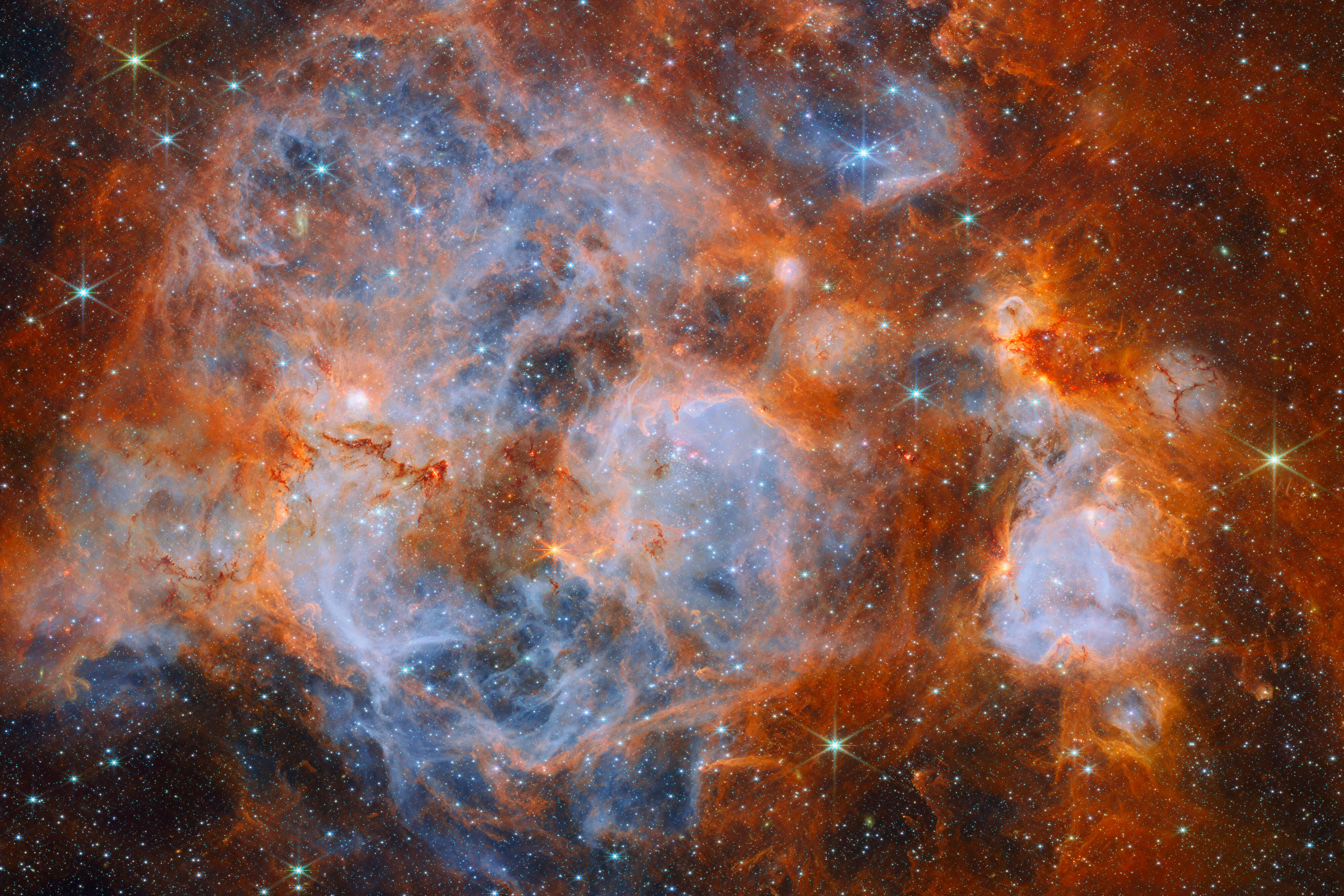
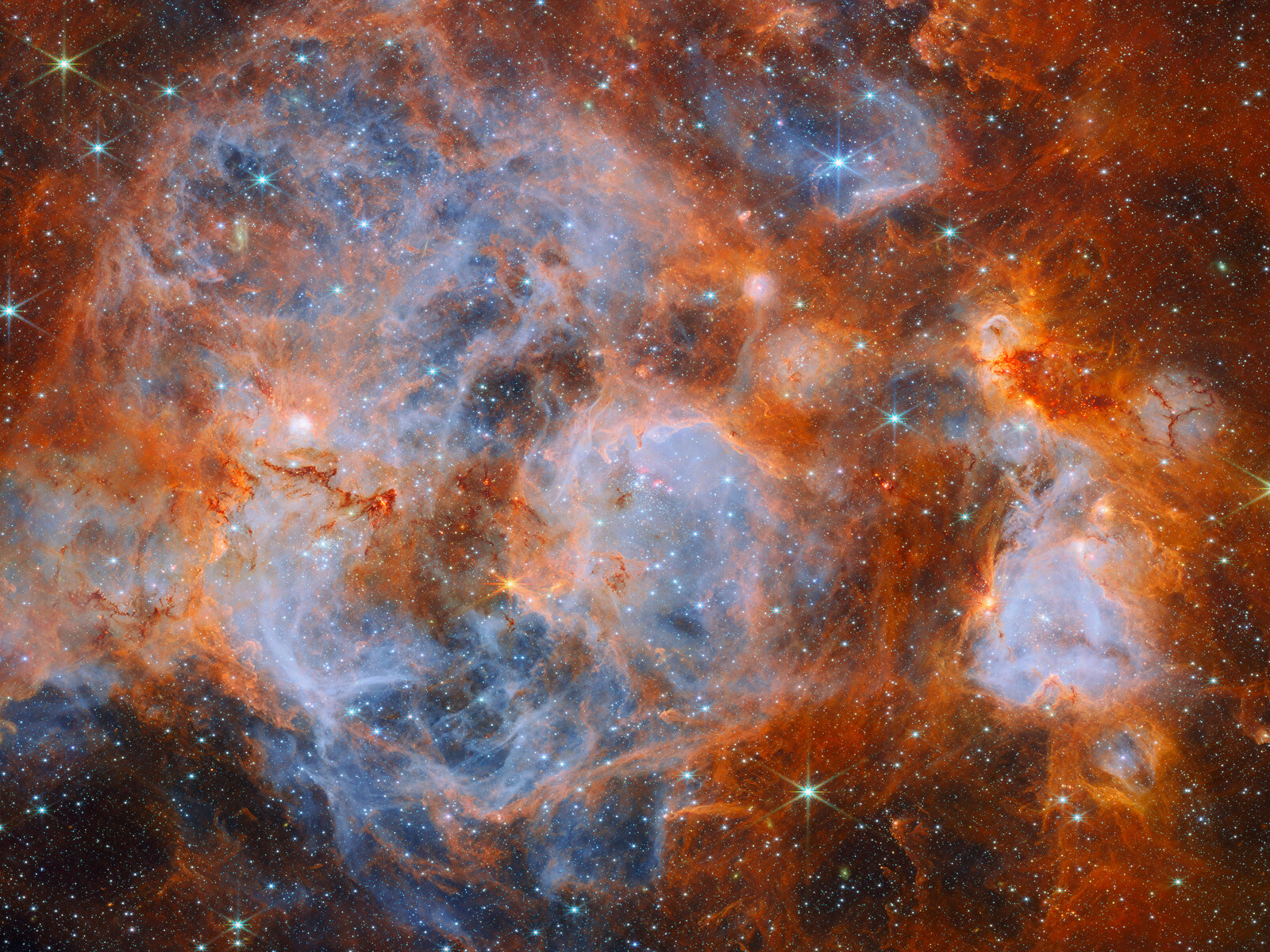
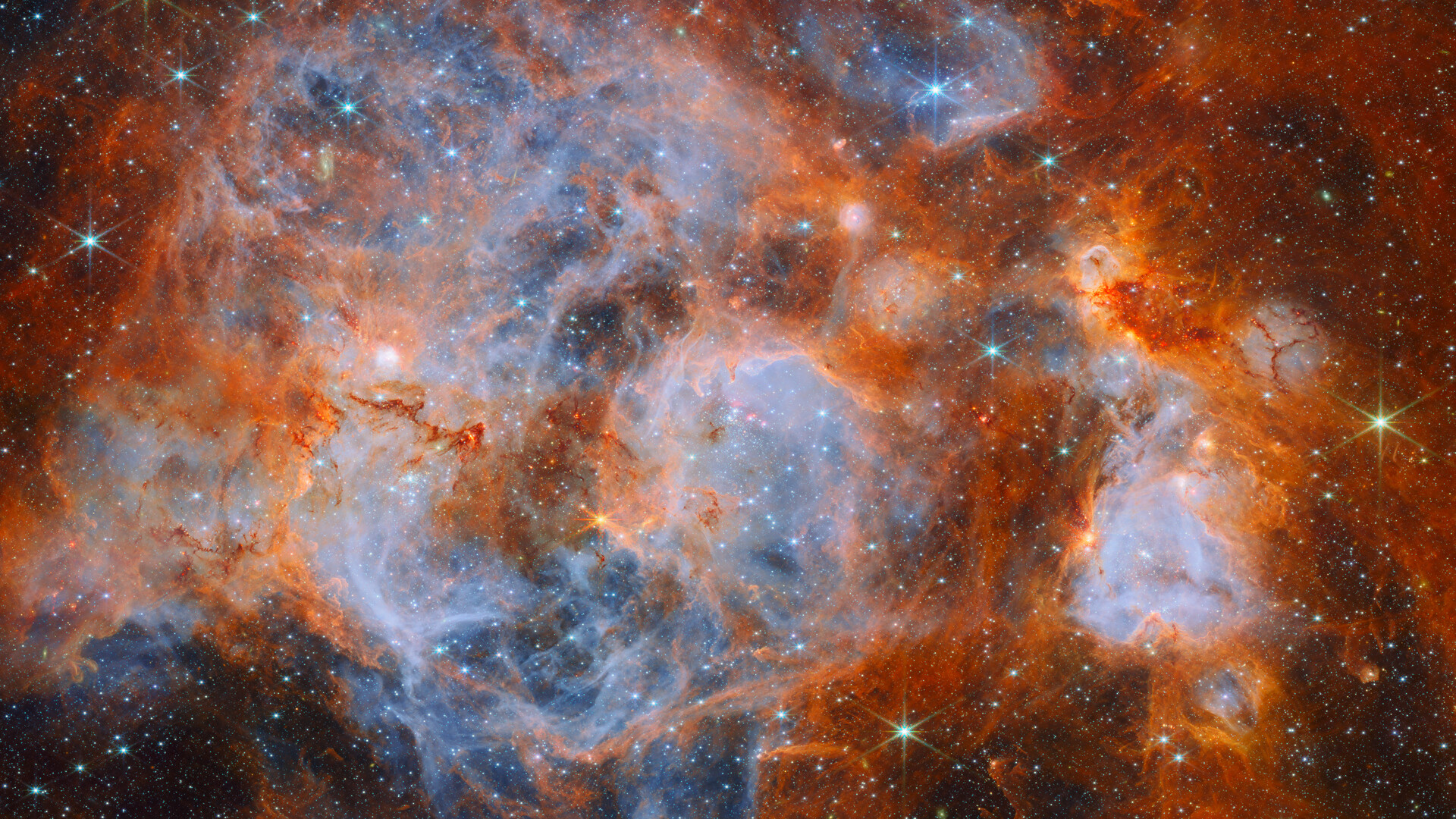
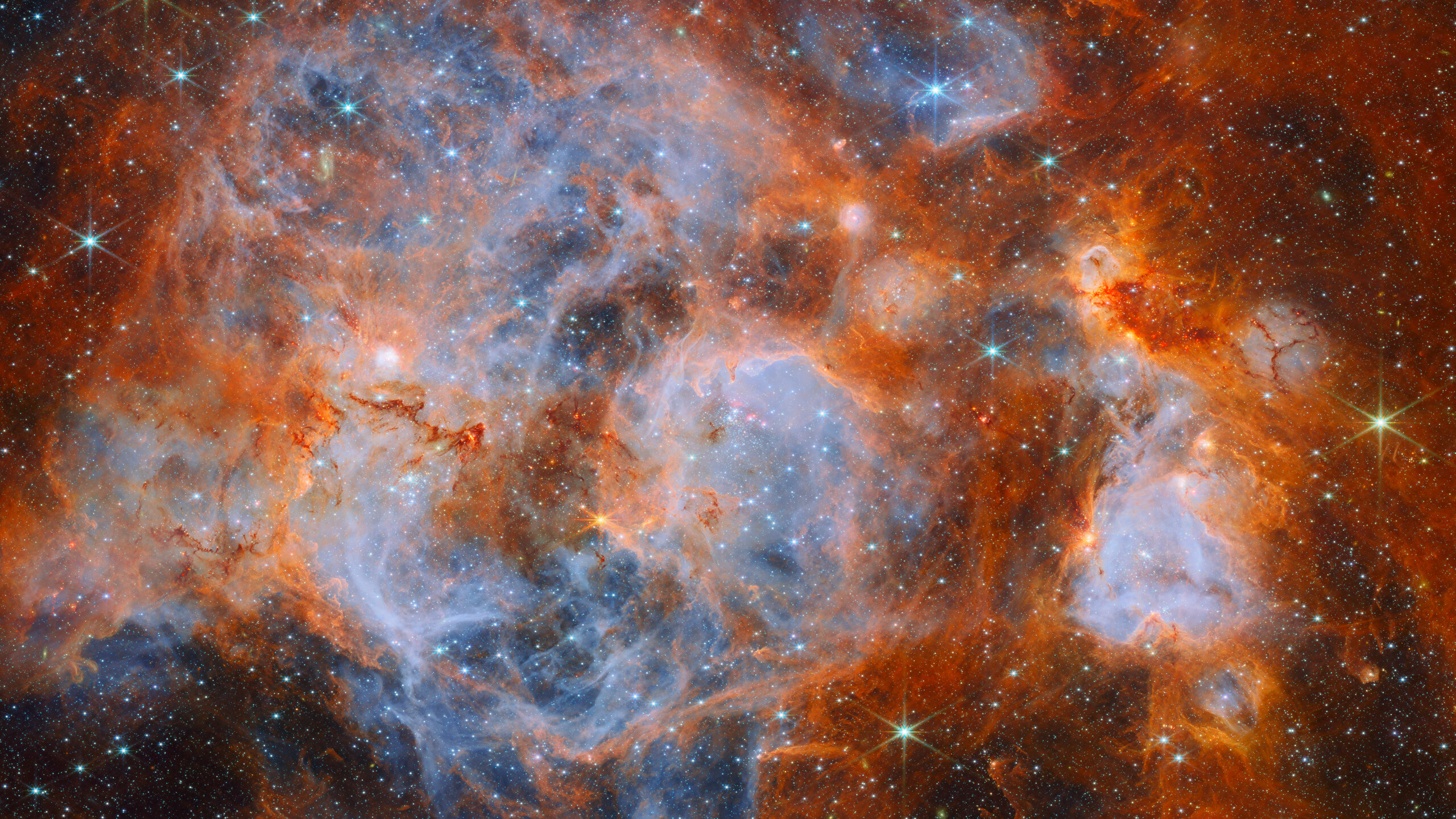
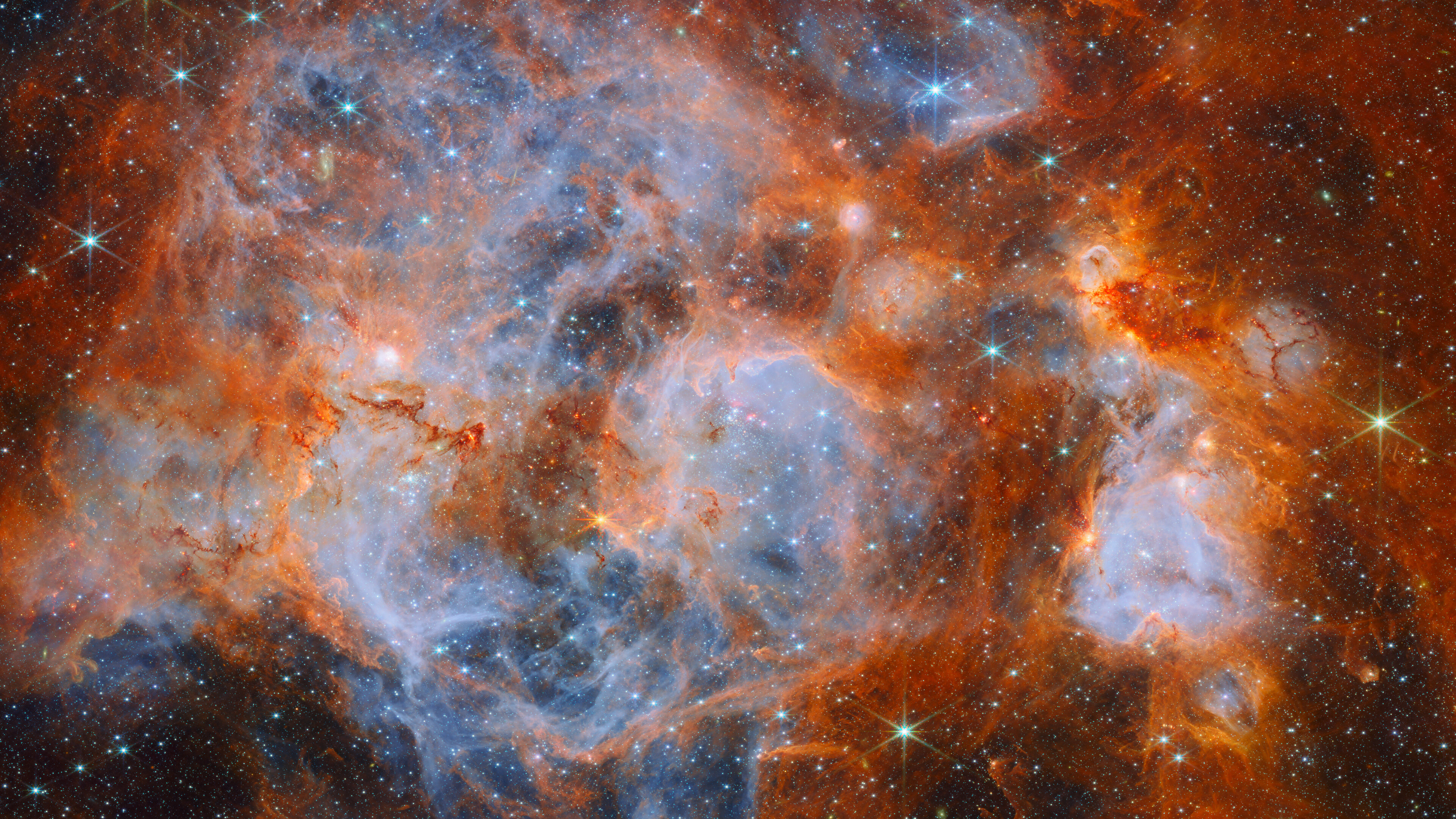
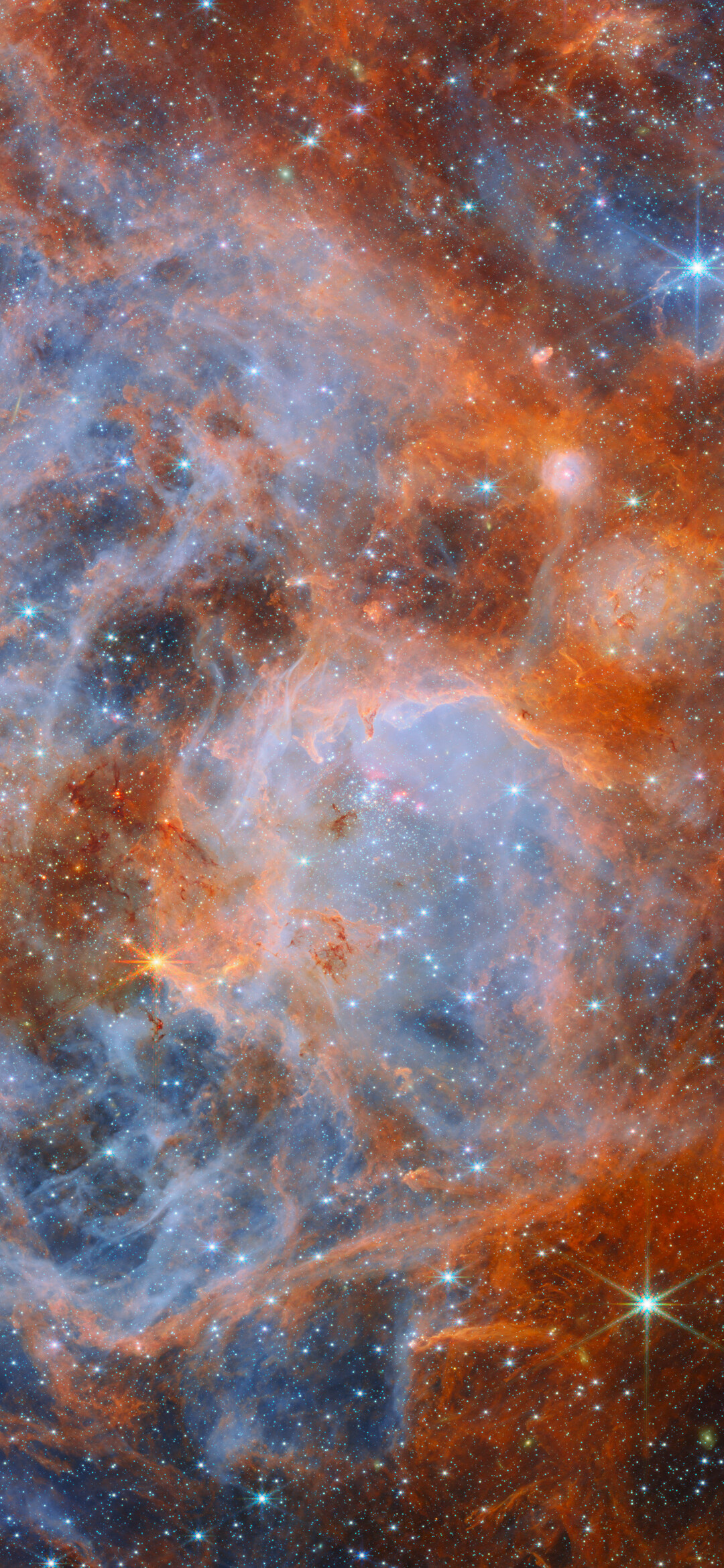
In this Picture of the Month from the NASA/ESA James Webb Space Telescope, we visit a turbulent cauldron of star formation to see what is brewing inside dense clumps of gas. This is a star-forming region named LHA 120-N 159, or simply N159, located 161 000 light-years away in the Large Magellanic Cloud (LMC), one of the satellite galaxies orbiting the Milky Way galaxy. This image spans about 230 light years across.
N159 is what astronomers call a H II region: an area of space filled with ionised hydrogen gas. In stellar nurseries such as this one, giant molecular clouds of cold hydrogen gas collapse under gravity, forming new stars. Many of these stars are extremely massive and hot, and their powerful ultraviolet radiation ionises the gas around them. This makes H II regions markers of active star formation, and as the ionised gas radiates light this turns them into the kind of brilliant emission nebula that we see in this image. The fierce stellar winds from these stars sculpt dense ridges and carve open cavities in the gas, which Webb’s Near-Infrared Camera (NIRCam) captures here in great detail.
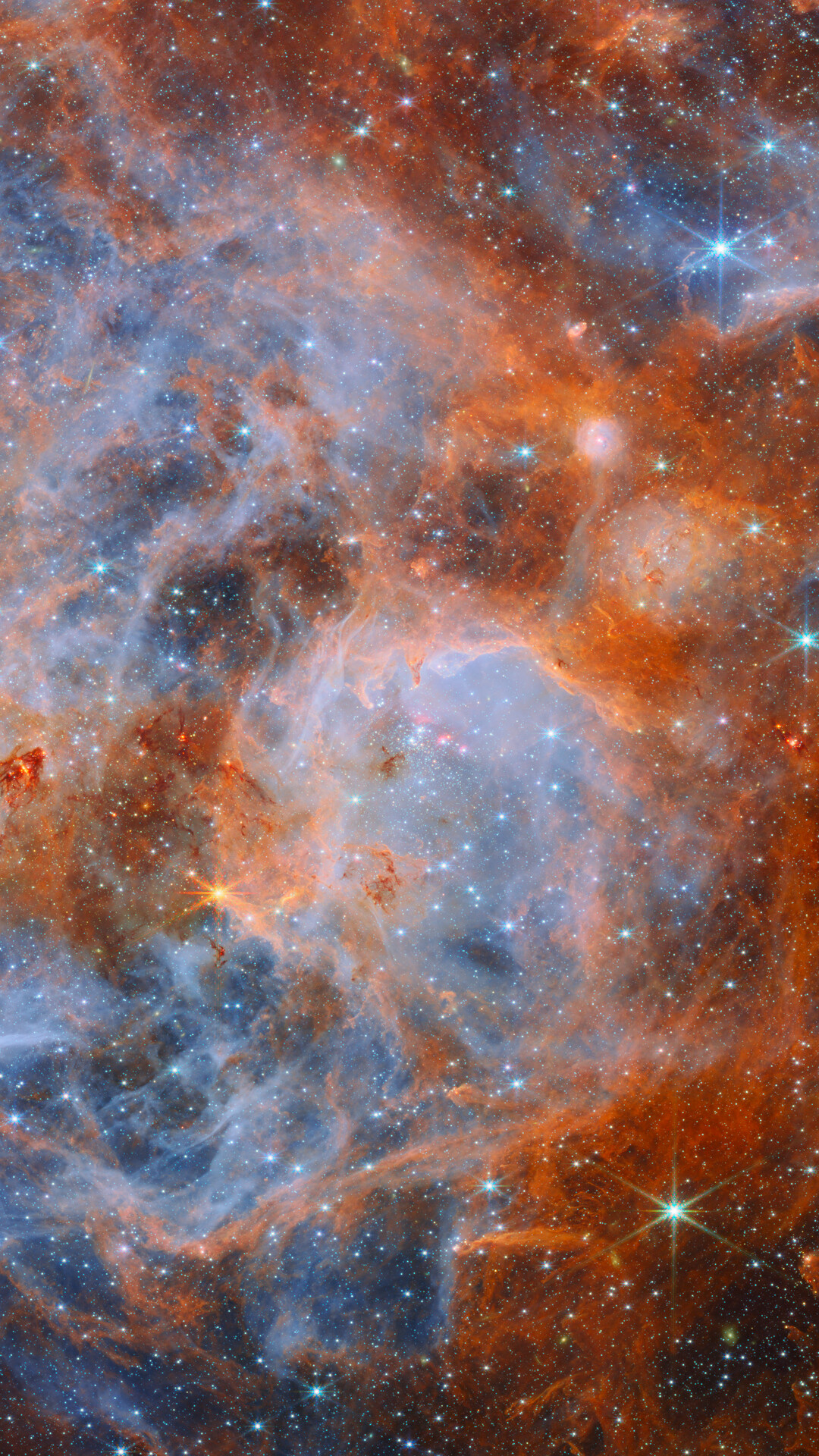
The roiling brew of star formation in N159 is closed in by thick, smoky orange clouds that also billow across the centre of the image. The light orange colour signifies light emitted by polycyclic aromatic hydrocarbons, an important carbon-based molecule. The pools of pale blue gas are clouds of H II gas, ionised by the intense ultraviolet light from massive stars. Dark red filaments cross the centre of the image, particularly visible above the blue region on the right side; these are made of cool molecular hydrogen. These filaments are the densest part of the nebula and currently shield new stars from harsh radiation and stellar winds — by zooming in, you can see stars as points of light embedded in these filaments and in the small pillars of orange gas that reach out into the blue bubbles. Eventually, these structures will melt away, leaving their completed stars behind.
The LMC is full of H II regions like N159 conveniently located for us to study, including the larger N79 region and the spectacular Tarantula Nebula. They are not exactly like the star-forming regions within our own galaxy: the LMC’s metallicity — its proportion of the elements, which astronomers call “metals”, that are heavier than hydrogen and helium — is significantly lower than in the Milky Way galaxy. This gives researchers an opportunity to study H II regions in conditions that are more similar to those found in the early Universe, helping us to learn about star formation in that time.
At less than three million years old, N159 is one of the youngest star-forming regions of the LMC, containing thousands of stars at their earliest stages of formation. Since the advent of space telescopes astronomers have closely examined the stellar populations in N159. The brightly glowing spot on the left side of the image is the Papillon Nebula, an exceptionally compact blob of ionised hydrogen that is thought to be linked to the formation of massive stars: it was resolved for the first time by the NASA/ESA Hubble Space Telescope in 1999. Sections of the sweeping clouds of gas were featured in a pair of images from Hubble in 2025, covering east and west sides of the cloud.
The data used in this new Webb image come from an observing programme (#5114) aiming to study and compare stars throughout their different stages of evolution in this giant nebula. In the resulting paper, astronomers delved into N159 with greater detail thanks to these new and comprehensive Webb data. They were able to detect extremely dim stars less than a tenth as massive as the Sun, and distinguish larger, hotter, fully evolved stars from the young stellar objects still wrapped up in the thick clouds where they are born. Their results showed that the western region of N159 has more of these young stellar objects in a more concentrated area, showing that it is at an earlier stage of collapsing to form stars. With the whole sequence of star formation taking place at once, N159 is a unique place to see the evolution of a collapsing molecular cloud up close.
[Image Description: A nebula made of clouds of gas and dust with stars forming within. In the centre and out to the left it is filled with thin, wispy blue gas that forms delicate layers. Around this are thicker orange clouds with dark ridges. Thin red filaments of gas cross the centre of the nebula. Glowing bubbles in the gas contain dense, very bright clusters of stars. In the edges, distant stars are visible as bright points on a dark background.]
Links
- N159 wide view
- Pan video: N159
- Zoom video: N159
- Space Sparks #32: N159
- Image on ESA website
- Science paper (N. Habel et al.)
ESA/Webb, NASA & CSA, E. Sabbi, M. Zamani (ESA/Webb)
Acknowledgement: M. H. Özsaraç
About the Image
| Id: | potm2610a | |
|---|---|---|
| Type: | Observation | |
| Release date: | 22 October 2026, 10:00 | |
| Size: | 9694 x 6463 px | |