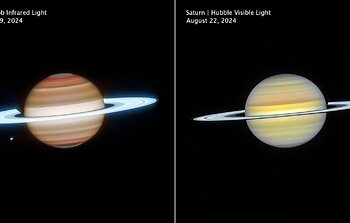
The NASA/ESA/CSA James Webb Space Telescope and the NASA/ESA Hubble Space Telescope have joined forces to capture new views of Saturn, revealing the planet in strikingly different ways.
Read more
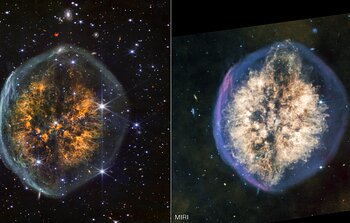
Astronomers are losing their heads over the latest images from the NASA/ESA/CSA James Webb Space Telescope, which bear a striking resemblance to a transparent cosmic cranium, revealing the “brain” inside. The nebula, officially named PMR 1, is being created by an aging star that is expelling its outer layers.
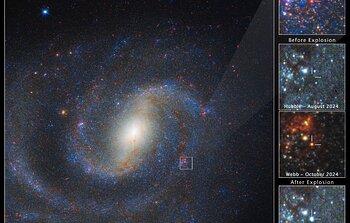
For the first time, astronomers have used images from the NASA/ESA/CSA James Webb Space Telescope to identify a supernova progenitor that could not be seen by any other telescope: a red supergiant that was located in a nearby galaxy. The supergiant’s surroundings were surprisingly dusty - dusty enough to render it invisible to the NASA/ESA Hubble Space Telescope.
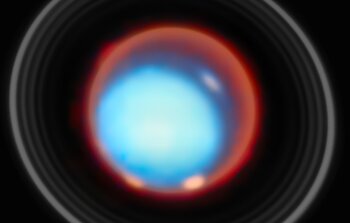
For the first time, an international team of astronomers have mapped the vertical structure of Uranus’s upper atmosphere, uncovering how temperature and charged particles vary with height across the planet. Using Webb’s NIRSpec instrument, the team observed Uranus for nearly a full rotation, detecting the faint glow from molecules high above the clouds. These unique data provide the most detailed portrait yet of where the planet’s auroras form, how they are influenced by its unusually tilted magnetic field, and how Uranus’s atmosphere has continued to cool over the past three decades. The results offer a new window into how ice-giant planets distribute energy in their upper layers.
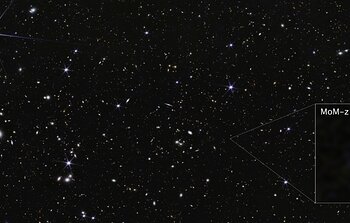
The NASA/ESA/CSA James Webb Space Telescope has topped itself once again, delivering on its promise to push the boundaries of the observable Universe closer to cosmic dawn with the confirmation of a bright galaxy that existed 280 million years after the Big Bang.
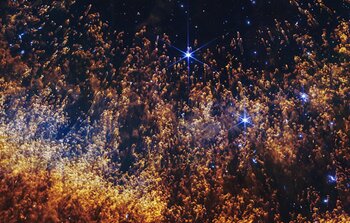
First spotted in the early 1800s, the Helix Nebula has become one of the most iconic planetary nebulas in the sky as it’s recognised for its striking, ring-like shape. One of the closest planetary nebulas to Earth, it has become a favourite among astronomers using ground- and space-based telescopes to study the final moments of a dying star in the greatest detail. The NASA/ESA/CSA James Webb Space Telescope has now leveled those studies up, offering the clearest infrared look at this familiar object.