
weic2624 — Science Release
Webb shows how supernova dust chronicles star evolution
Dust formed after the supernova shows how changes within a soon-to-explode star influenced the elements it released
23 November 2026
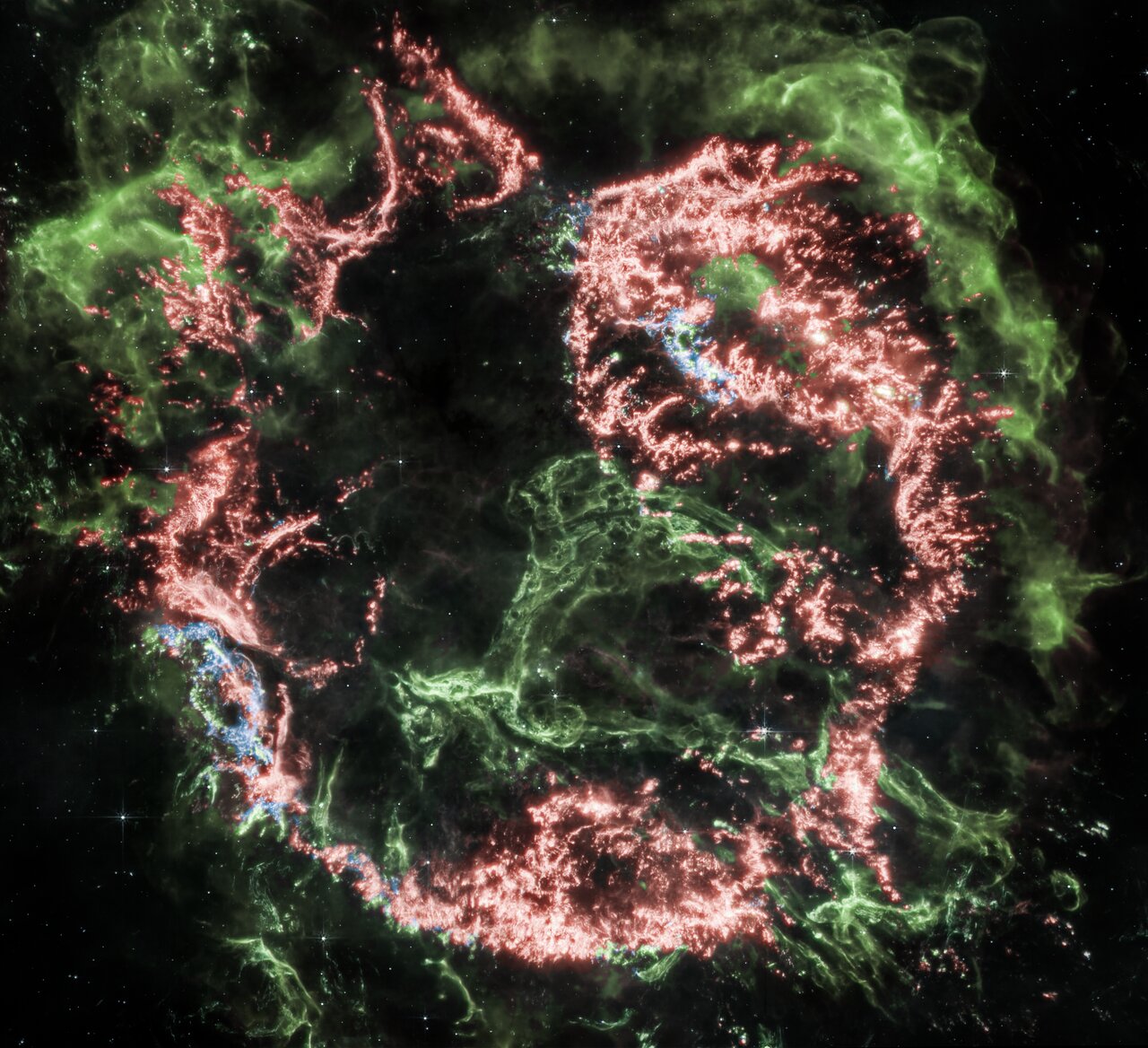
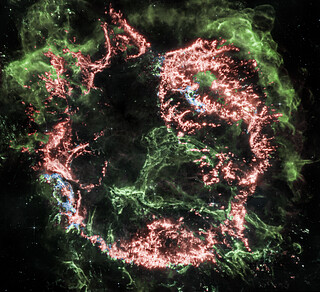
The NASA/ESA/CSA James Webb Space Telescope captured the mid-infrared light of Cassiopeia A (Cas A), one of the most well-studied supernova remnants, to characterise its dust. Astronomers used Webb’s detailed observations to gain new insights into shell mergers, a process that is theorised to occur mere hours before a star’s supernova explosion, revealing new details about the structure of Cas A’s original star.
The James Webb Space Telescope paints a vibrant tapestry of the legendary supernova remnant Cassiopeia A (Cas A). Remnants like these are the clouds of gas and dust that remain following the explosion of a massive star and will eventually seed a new generation of stars and planets.
This high-resolution, mid-infrared observation reveals new details that are helping astronomers chronicle the structure and evolution of Cas A’s original star. The Webb data supports a scenario in which the interior of the star underwent a dramatic change, possibly just hours before its demise. These results were published today in The Astrophysical Journal Letters.
Stars begin their lives as large clouds of mostly hydrogen gas and cosmic dust called molecular clouds. Eventually, gravity causes these molecular clouds to collapse, the material heats up, and protostars stars — infant stars — form. Under the constant pressure of gravity, hydrogen within a protostar begins to fuse into helium, which marks the point where protostars evolve into full-fledged stars like our Sun.
As hydrogen in the core runs out, the core contracts and heats until helium begins to fuse into heavier elements. This process repeats as stars like Cas A’s original star evolve, with increasingly heavier elements fusing in the core (eventually stopping at iron) and lighter elements fusing in surrounding layers. This leads to multiple shells of elements that provide a record of a star’s evolutionary history. When a star goes supernova, these elements are scattered into the surrounding space, where some of them condense to form dust grains, which can clump together. By studying and mapping the composition of these individual, Solar-System-sized dust clumps in Cas A, Webb found evidence of a shell merger, a process in which the layers inside a star mix before the explosion.
“Material within these shells churns and circulates, which can cause the shells to merge shortly before the supernova explosion,” said Tea Temim, lead author of the study and research scientist from Columbia University in the United States. “So, for example, this would be something like the oxygen- and carbon-burning shells in a star merging together and changing the structure of the star significantly. And that would then change the chemical abundances that you would see after a supernova explosion in the ejecta of a supernova remnant.”
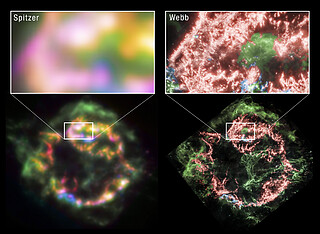
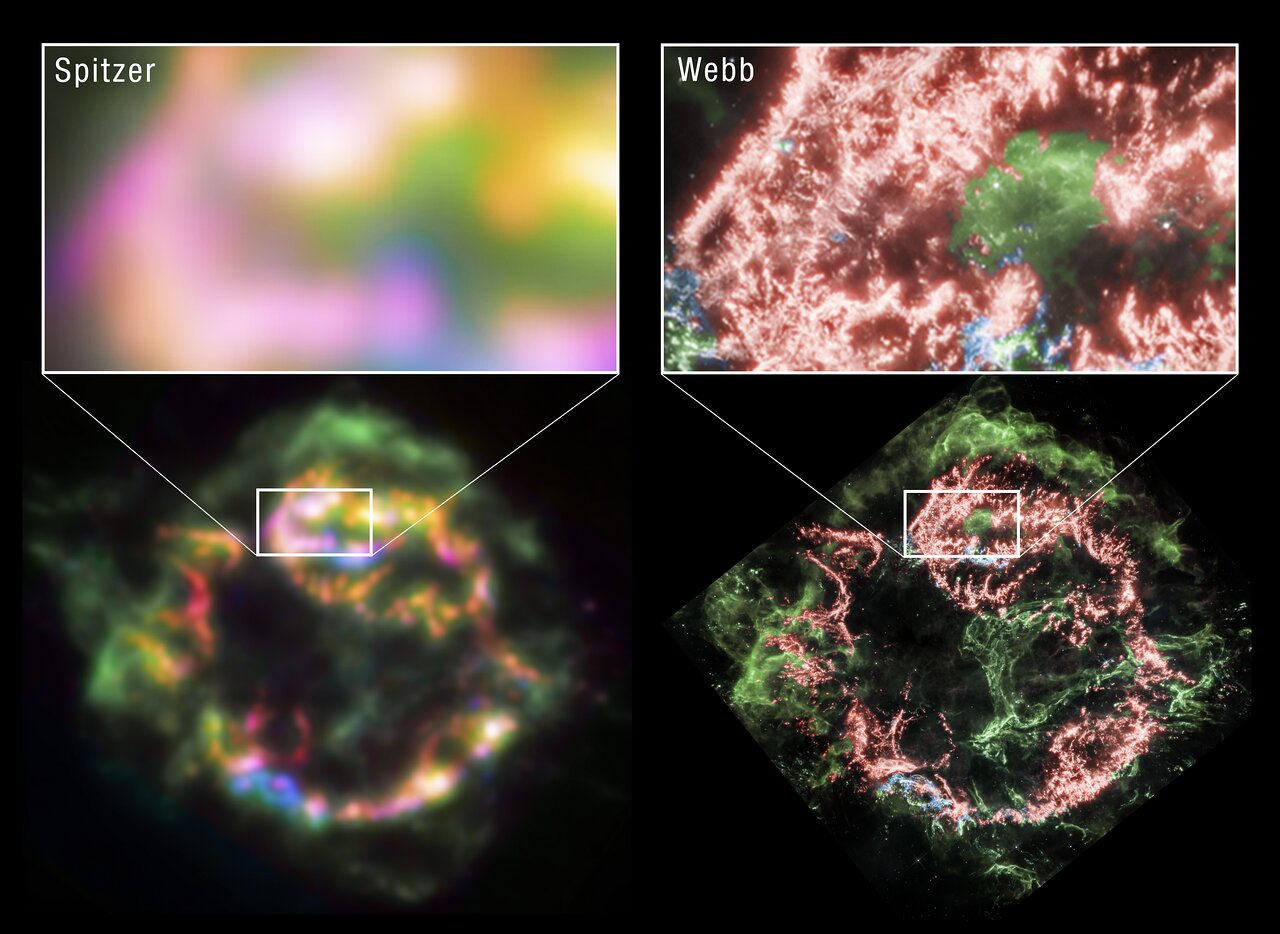
For the researchers to know where to look with Webb, they also leveraged data from NASA’s retired Spitzer Space Telescope. Although it couldn’t resolve the minute details of the region during its observation, Spitzer identified three specific regions to observe with Webb’s keen eye.
Two of the targets were inside Cas A’s reverse-shocked region, where an inward-moving shock wave collides with debris thrown outward by the supernova. Webb observed that the ejecta in one of the two contained mostly silica dust, while the other was dominated by carbon dust. "Identifying the different types of dust grains formed in the chemically distinct layers of a supernova brings us one step closer to understanding how much dust supernovae contribute to the interstellar dust reservoir in our galaxy," said Ilse De Looze, a co-author of the paper and associate professor at Ghent University in Belgium. "By revealing the composition of this newly formed supernova dust, JWST also provides crucial insights into how well these grains can survive the powerful reverse shocks that sweep through the supernova debris, ultimately determining how much dust can escape into the interstellar medium."
The third target was the “Green Monster,” a structure first discovered by Webb, which was found to be rich in complex magnesium silicates. Unlike the other two regions, the Green Monster originated from material the star shed before it exploded, rather than from the supernova’s ejecta.
Building on the X-ray observations of NASA’s Chandra X-ray Observatory and the JAXA-led XRISM, Webb mapped the dust composition of Cas A across the entire remnant, providing crucial insight into the shell merger phenomenon. Together, these observations indicate that the merger was underway very shortly before the supernova explosion.
“With Webb, the vast improvement in being able to resolve at the individual clump level helps us do more sophisticated dust chemistry,” said Dan Milisavljevic, associate professor and co-author of the study from Purdue University in the United States. “As a result, we can tie the explosion back to the makeup of the progenitor star hundreds of years afterward. It’s telling us about what was happening, we think, in the hours leading up to core collapse. Understanding this process is essential to explaining which elements the supernova explosion will release into the galaxy and how those elements enrich future generations of stars and planets.”
The dust map from Webb also reveals that the merger signatures are present throughout much of the supernova remnant. These efforts provide a new method for other astronomers that want to infer characteristics about an originating star’s structure by using the dust of a supernova remnant.
More information
Webb is the largest, most powerful telescope ever launched into space. Under an international collaboration agreement, ESA provided the telescope’s launch service, using the Ariane 5 launch vehicle. Working with partners, ESA was responsible for the development and qualification of Ariane 5 adaptations for the Webb mission and for the procurement of the launch service by Arianespace. ESA also provided the workhorse spectrograph NIRSpec and 50% of the mid-infrared instrument MIRI, which was designed and built by a consortium of nationally funded European Institutes (The MIRI European Consortium) in partnership with JPL and the University of Arizona.
Webb is an international partnership between NASA, ESA and the Canadian Space Agency (CSA).
Image Credit: NASA, ESA, CSA, T. Temim (Columbia University), R. Arendt (UMBC), D. Milisavljevic (Purdue University). Image Processing: J. DePasquale (STScI).
Links
Contacts
Bethany Downer
ESA/Hubble/Webb Chief Science Communications Officer
Email: [email protected]
ESA Newsroom and Media Relations Office
Email: [email protected]
Ann Jenkins
Space Telescope Science Institute
Email: [email protected]
About the Release
| Release No.: | weic2624 | |
|---|---|---|