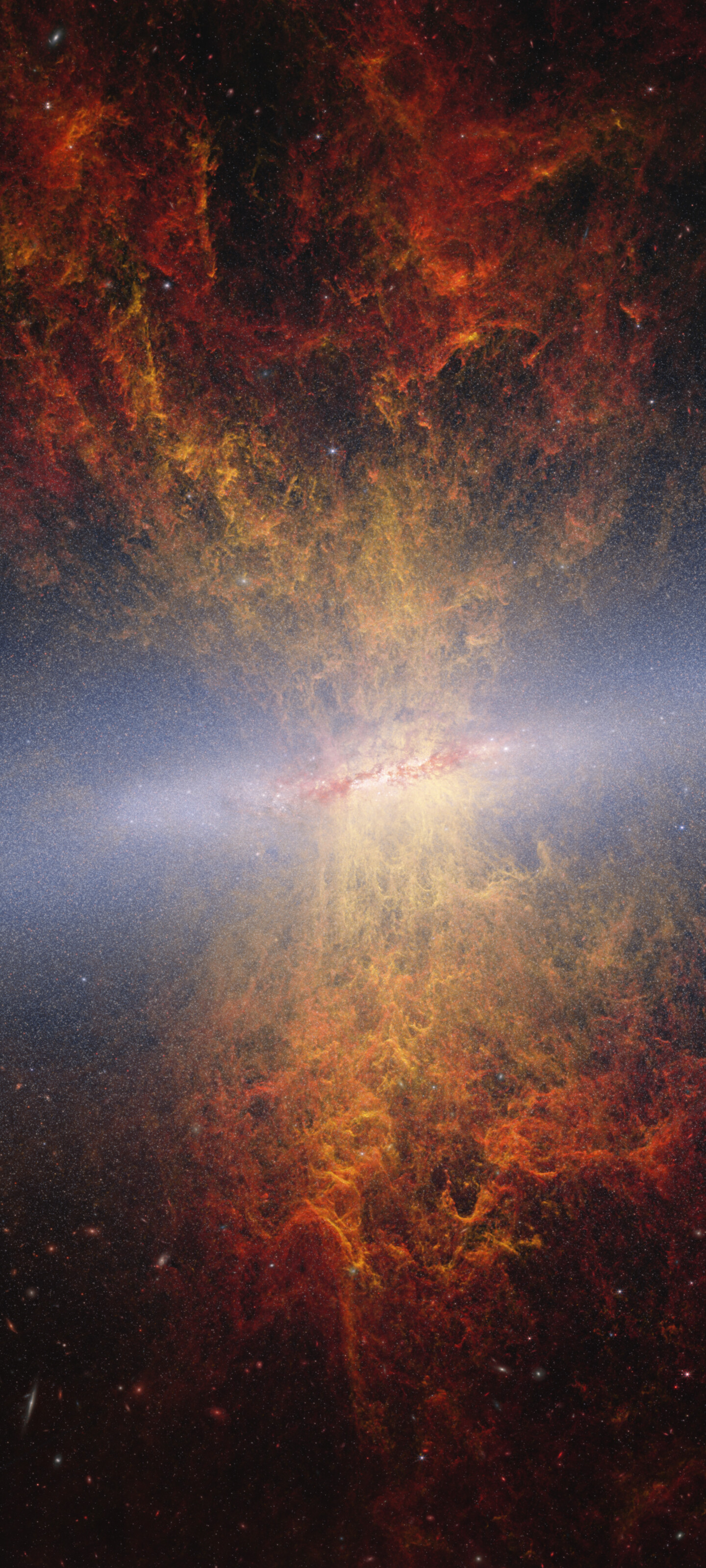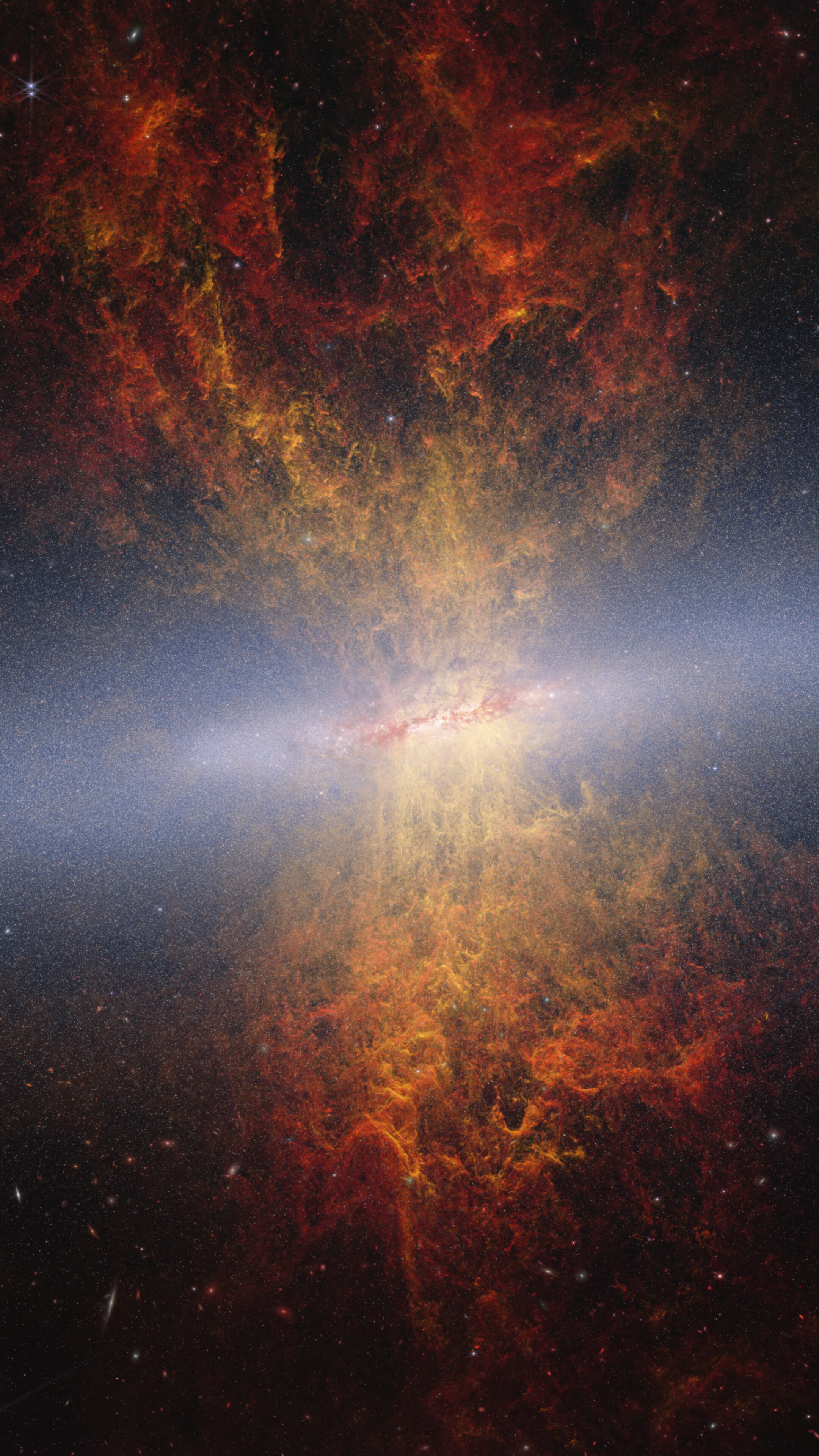

About the Object
| Name: | M82 | |
|---|---|---|
| Distance: |
12 million light years | |
| Constellation: | Ursa Major | |
| Category: | Galaxies NIRCam | |
Coordinates
| Position (RA): | 9 55 53.76 |
|---|---|
| Position (Dec): | 69° 40' 51.22" |
| Field of view: | 9.48 x 6.39 arcminutes |
| Orientation: | North is 32.3° left of vertical |


Interactive Sky View
Background Survey Options
Colours & filters
| Band | Wavelength | Telescope |
|---|---|---|
| Infrared (Blue) | 1.15 μm | James Webb Space Telescope NIRCam |
| Infrared (Cyan) | 2.0 μm | James Webb Space Telescope NIRCam |
|
Optical
(Yellow) N II | 658 nm | Hubble Space Telescope ACS |
|
Infrared
(Orange) PAH | 3.35 μm | James Webb Space Telescope NIRCam |
| Infrared (Red) | 4.44 μm | James Webb Space Telescope NIRCam |
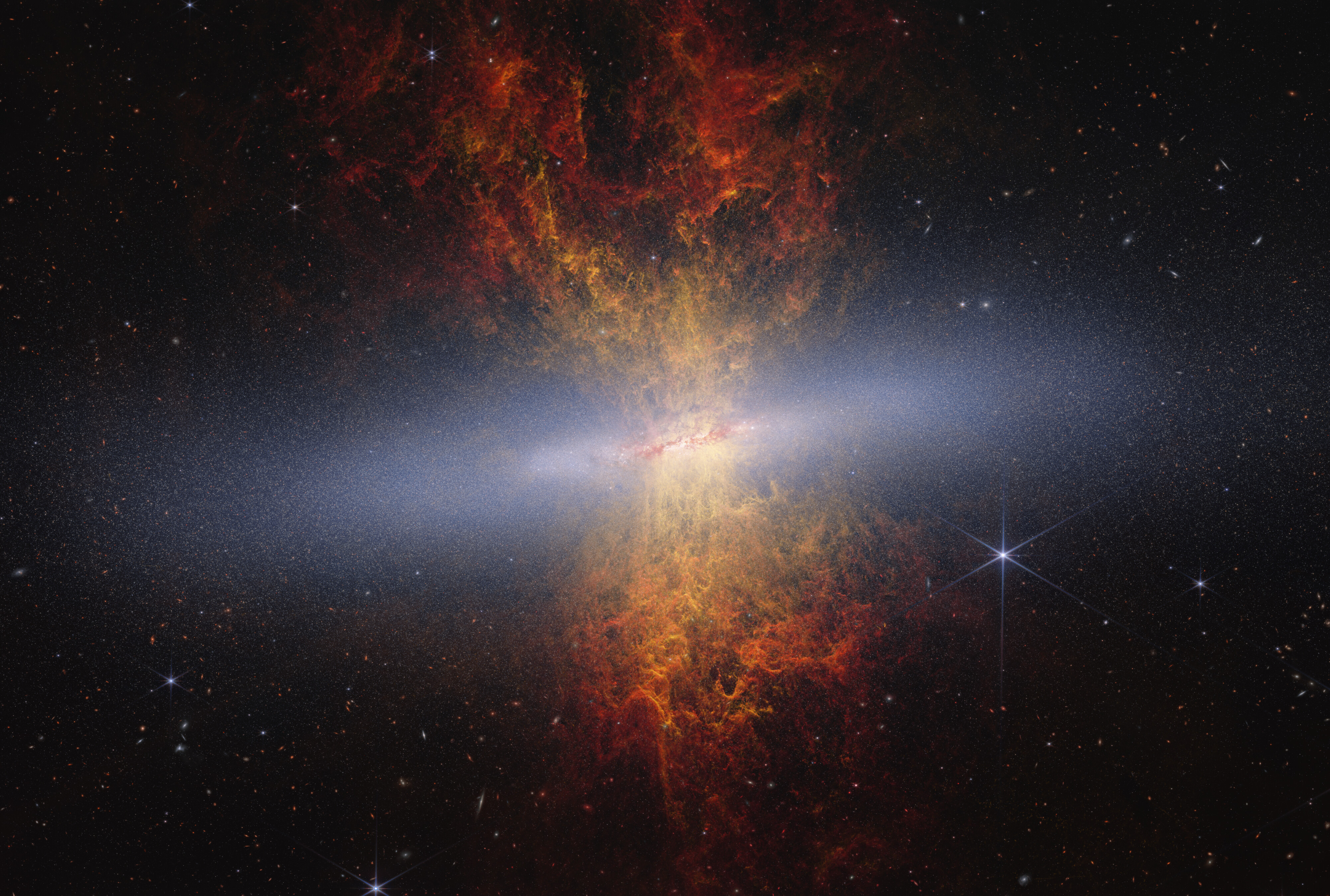
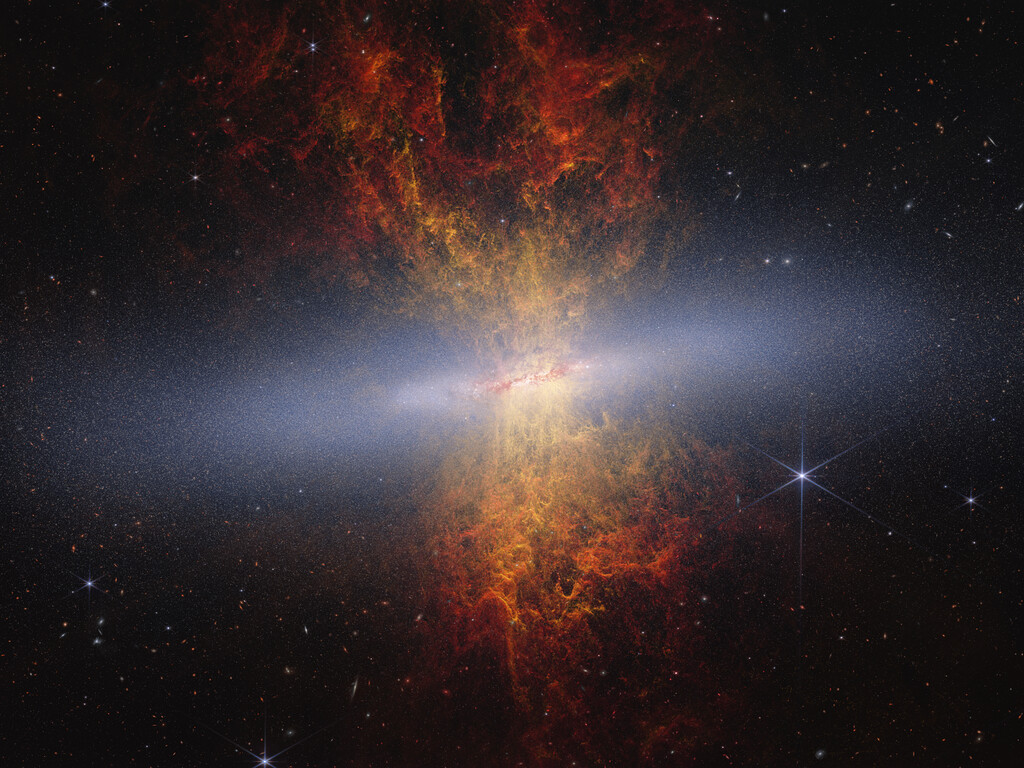
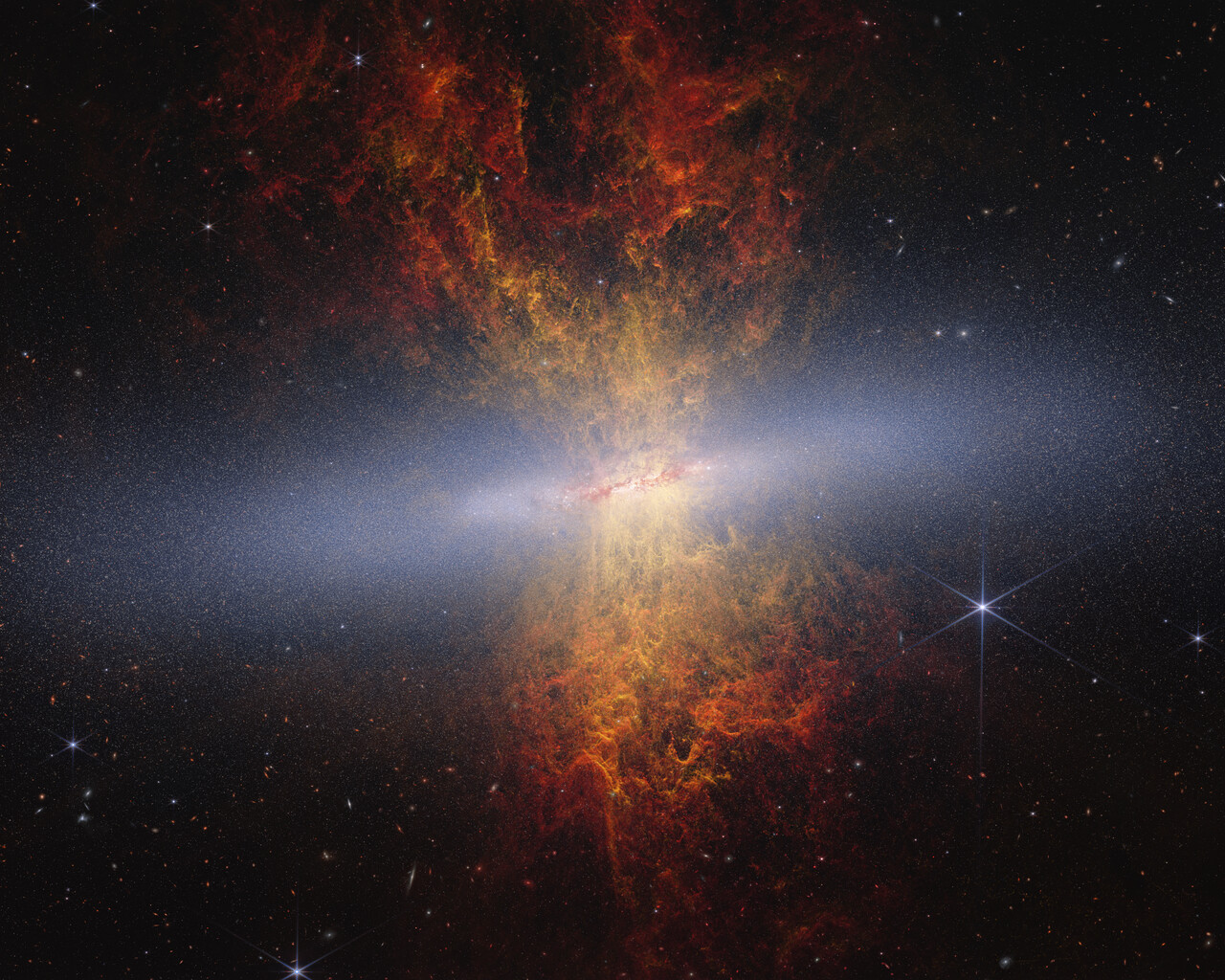
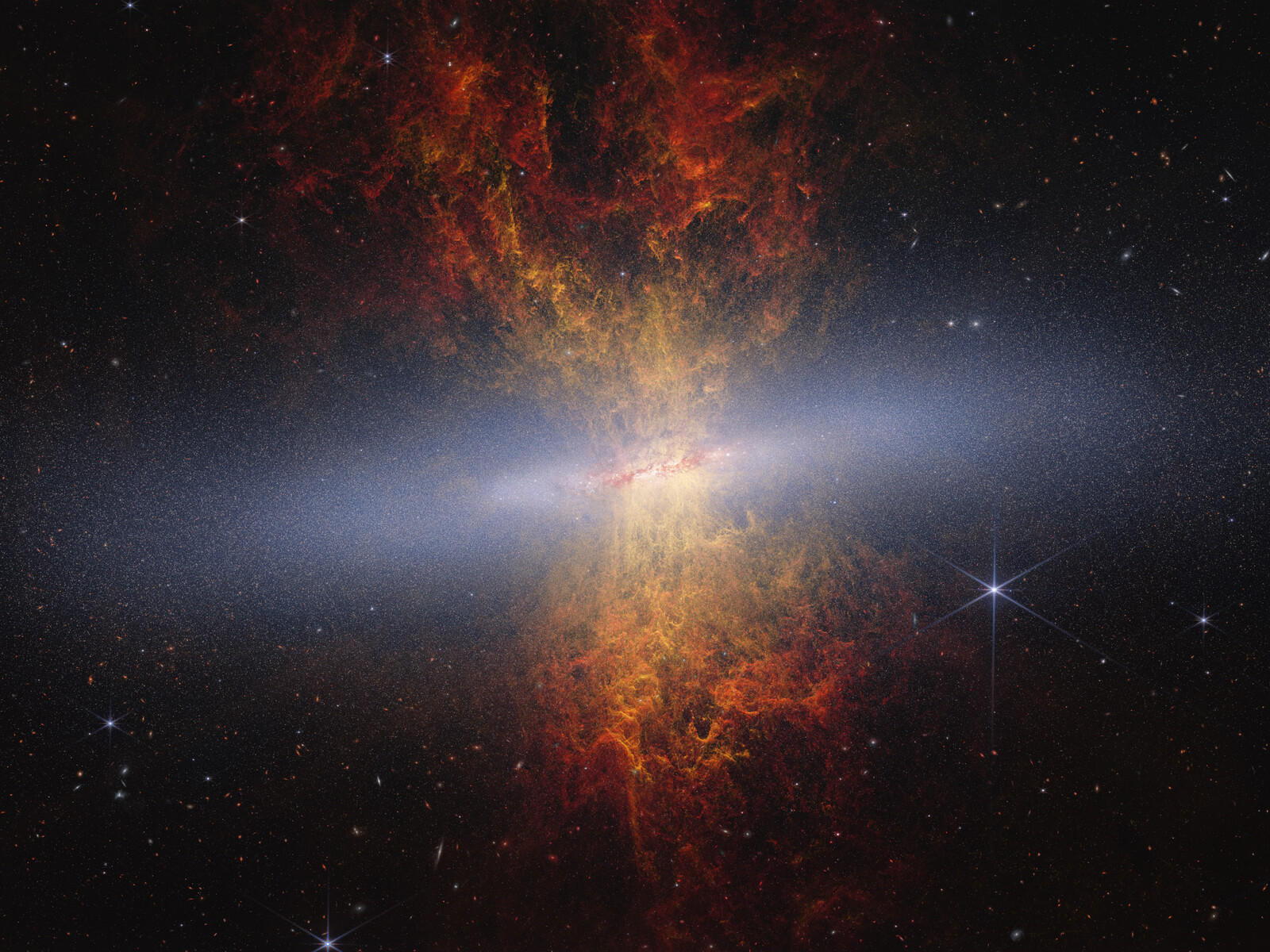
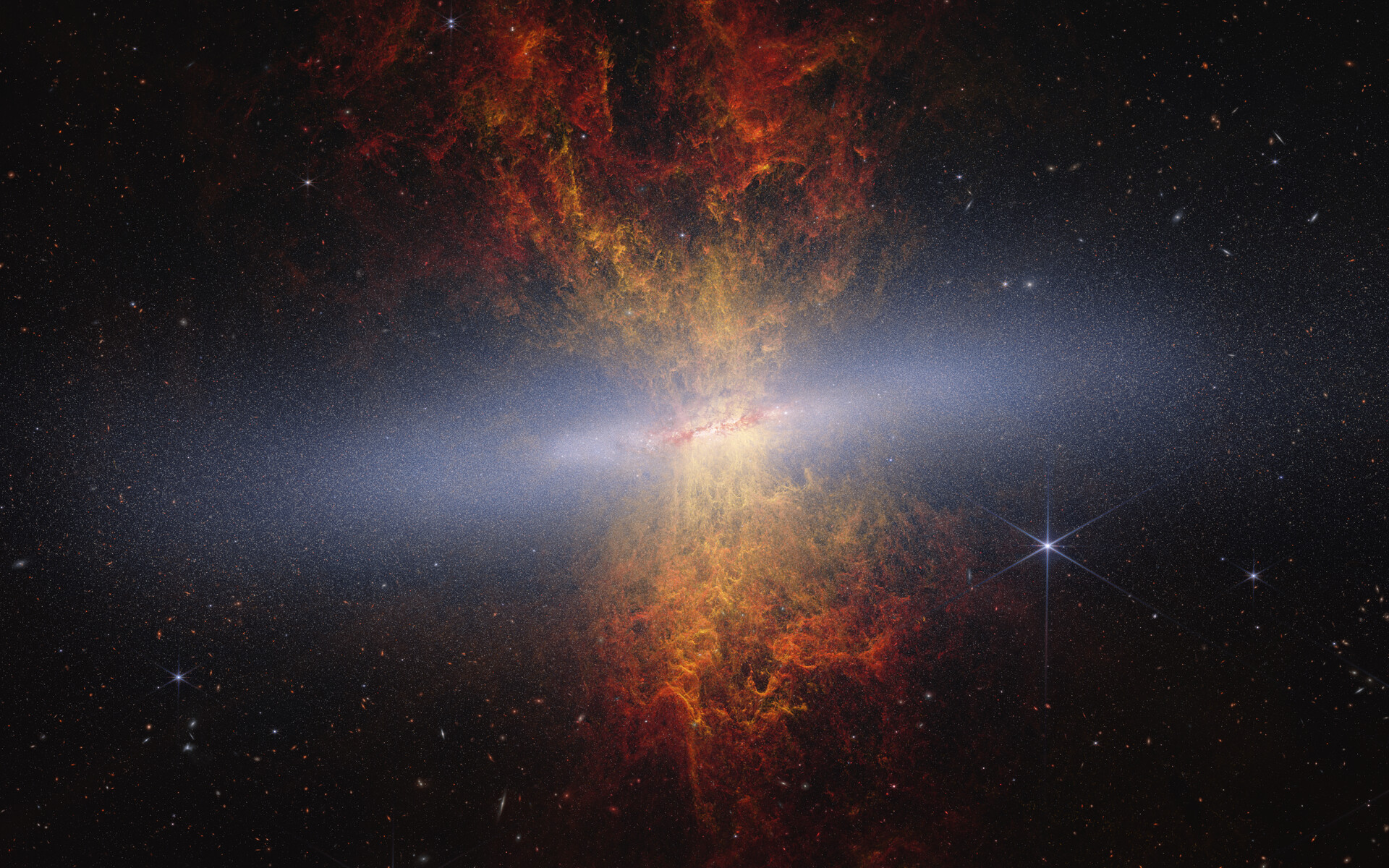
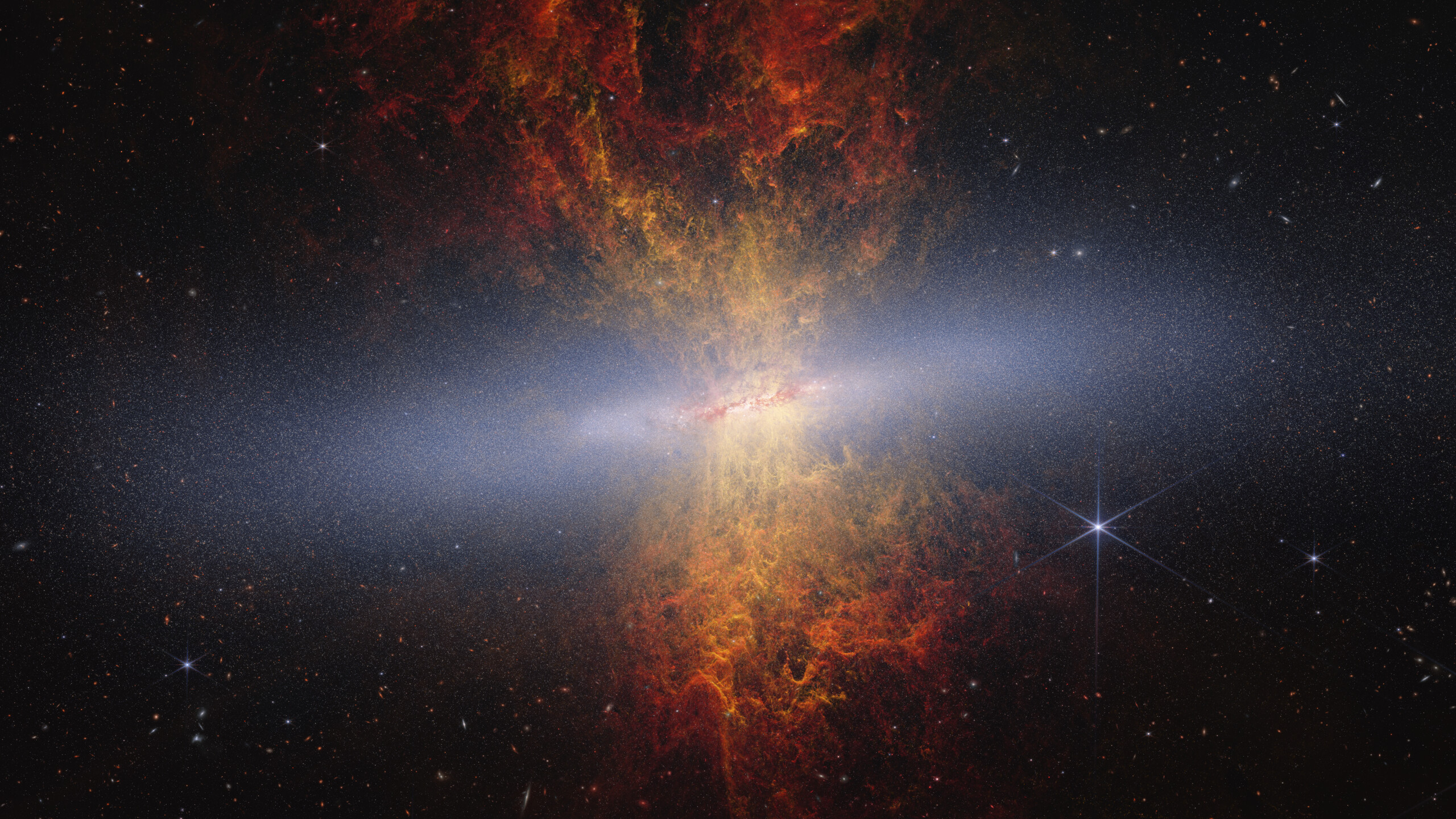
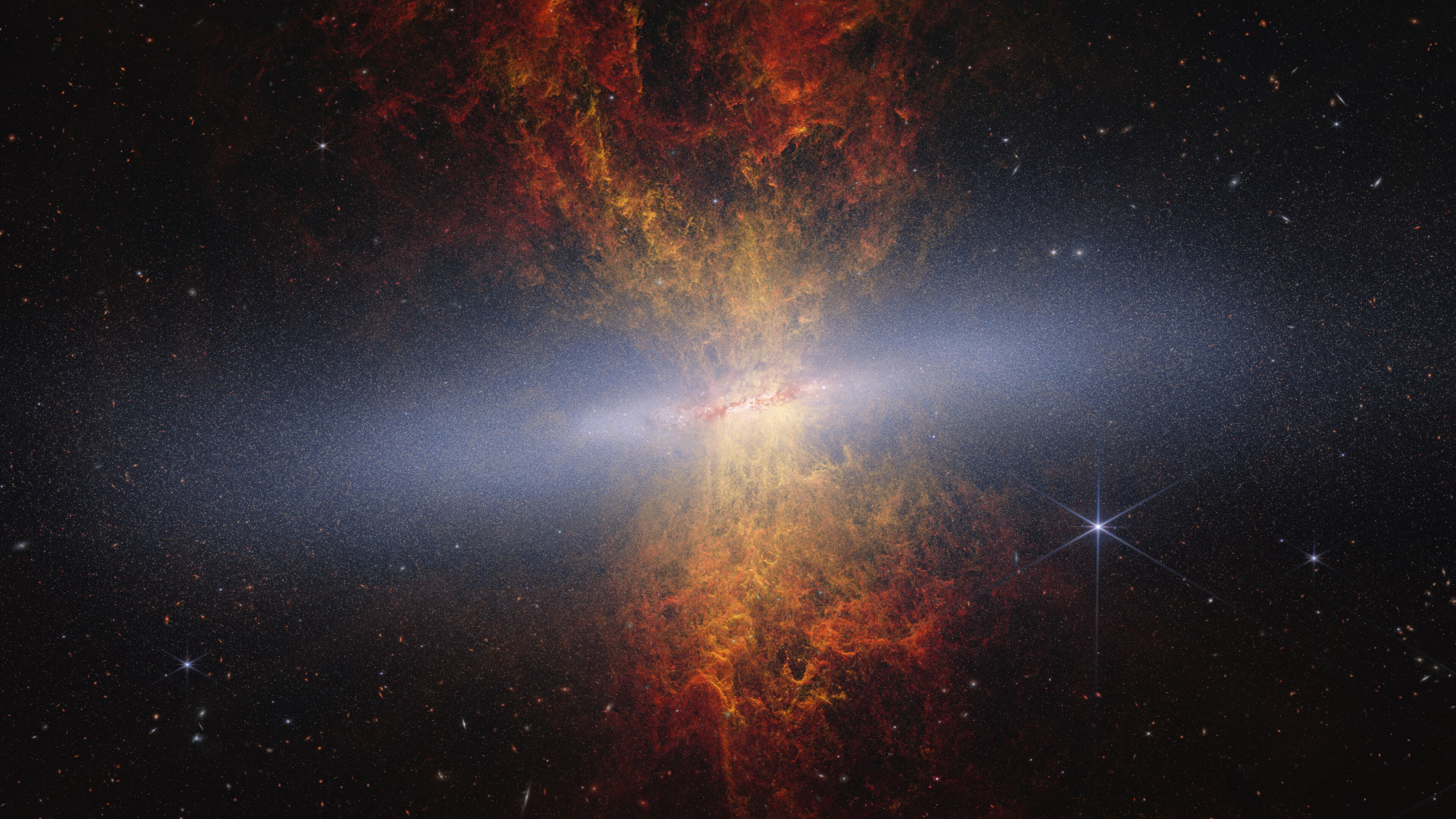
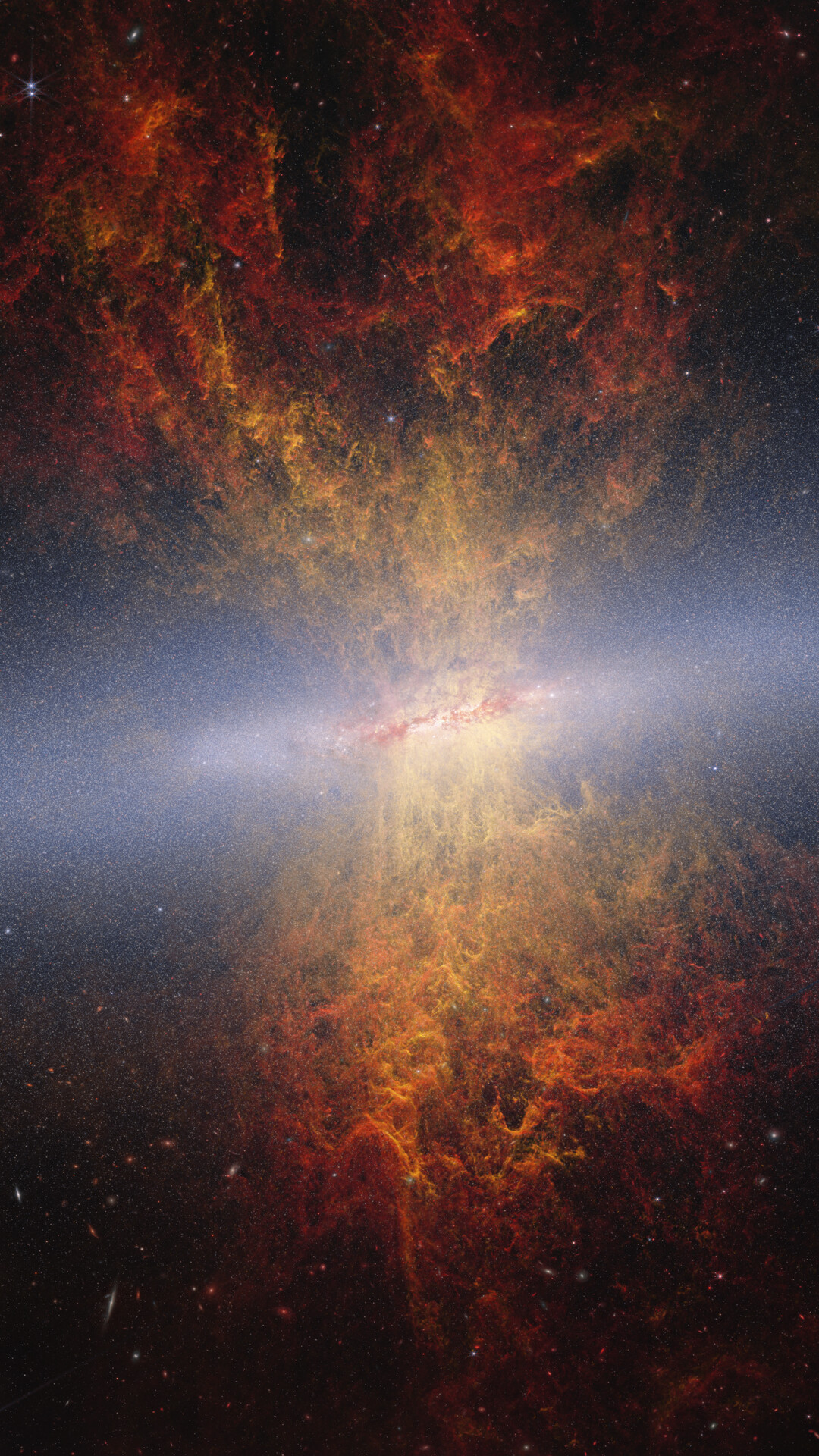
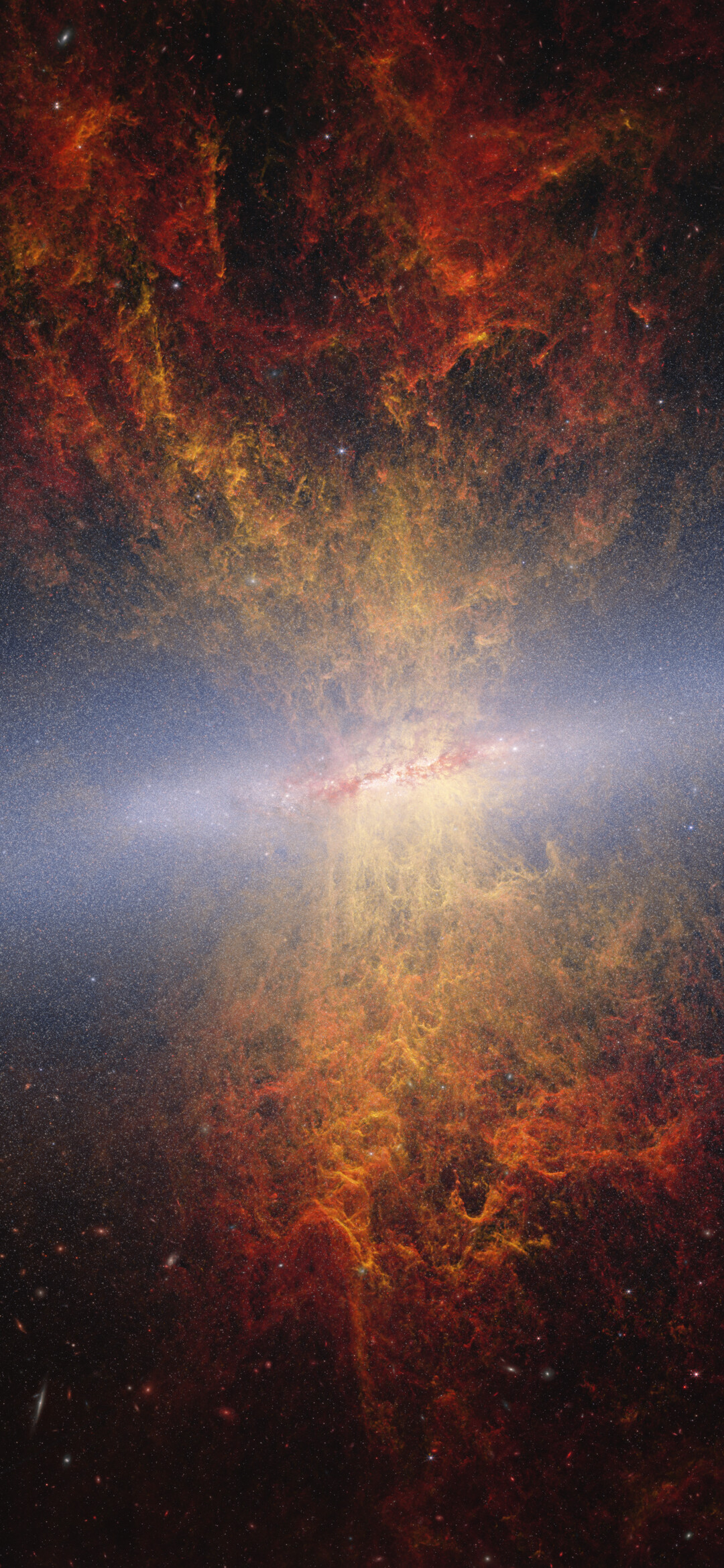
The Cigar Galaxy: M82 (Webb and Hubble image)
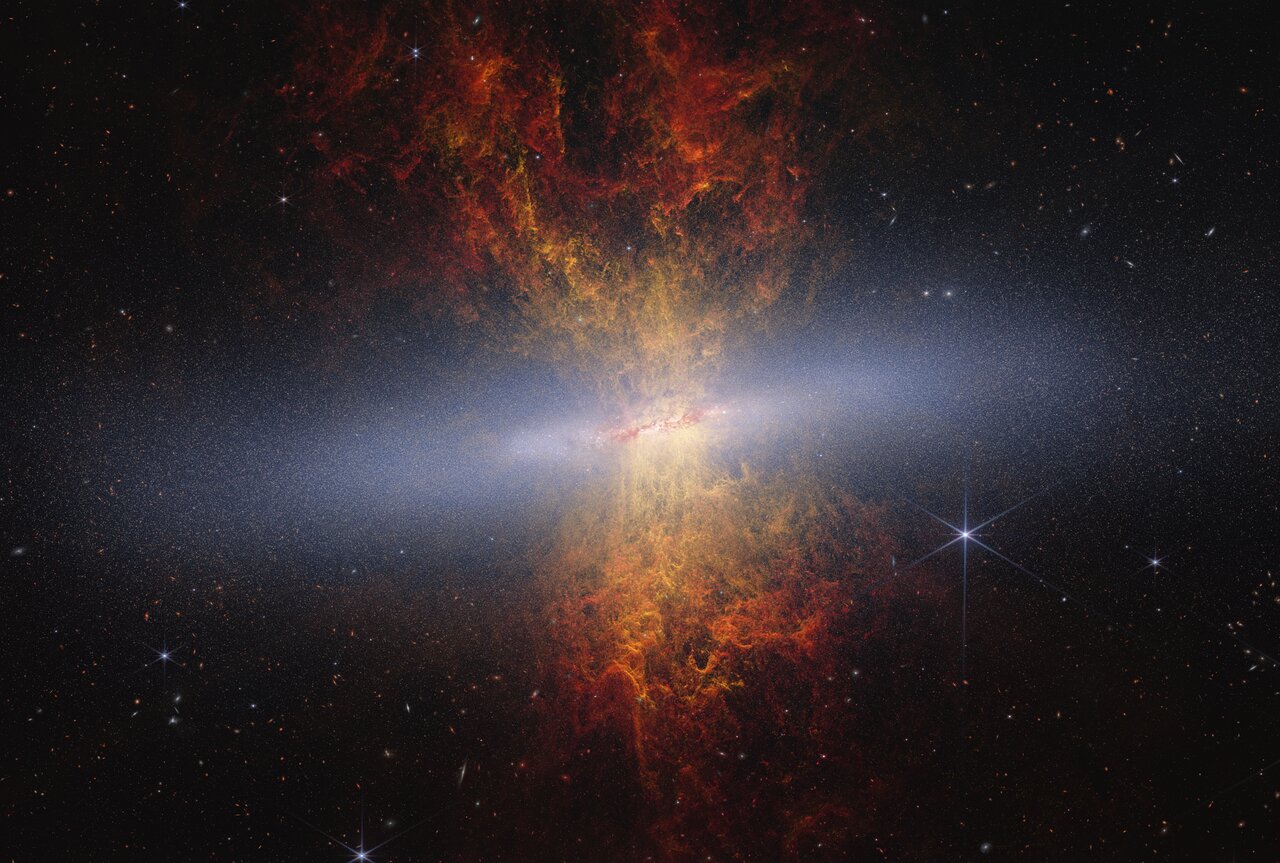
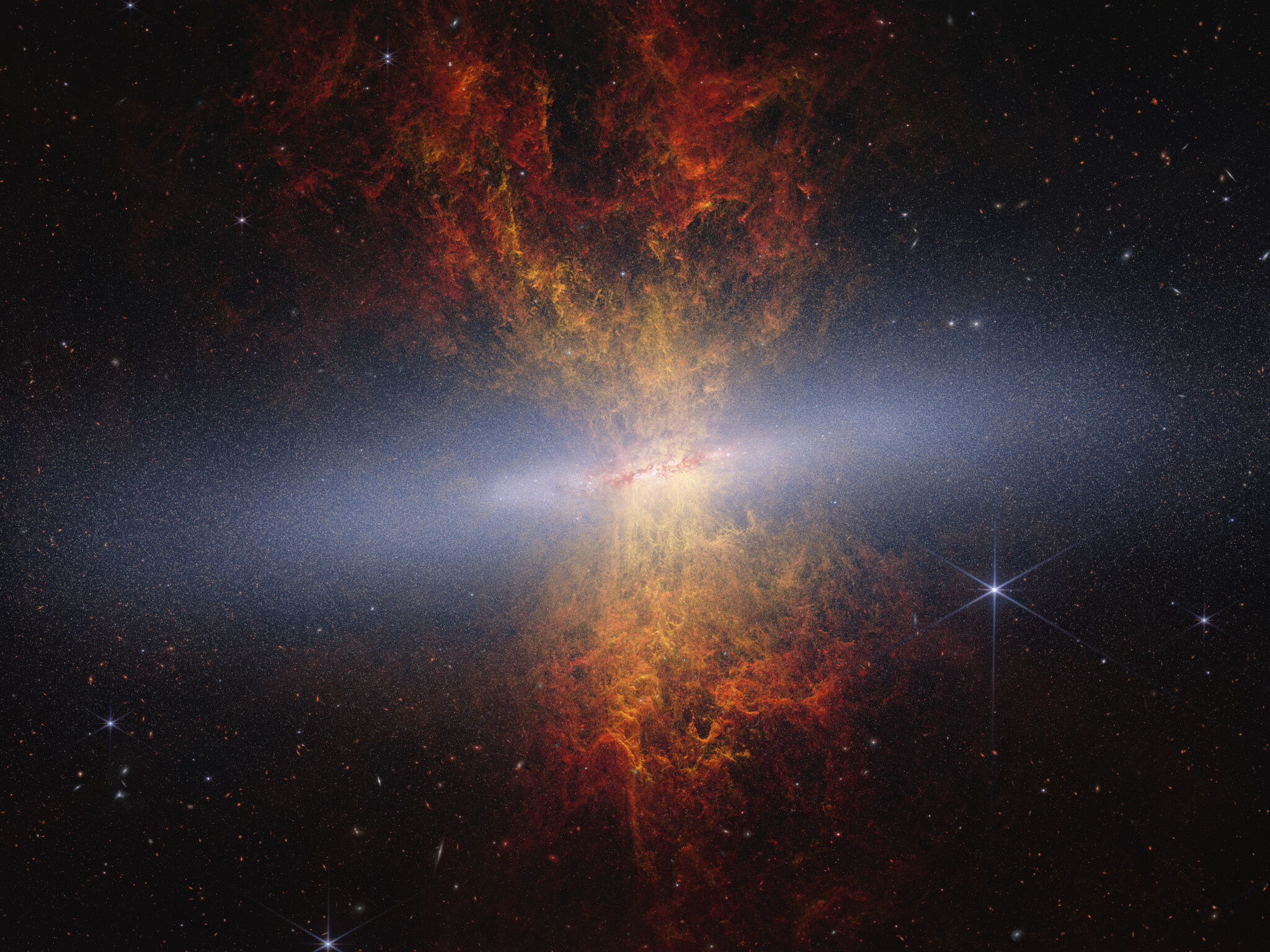
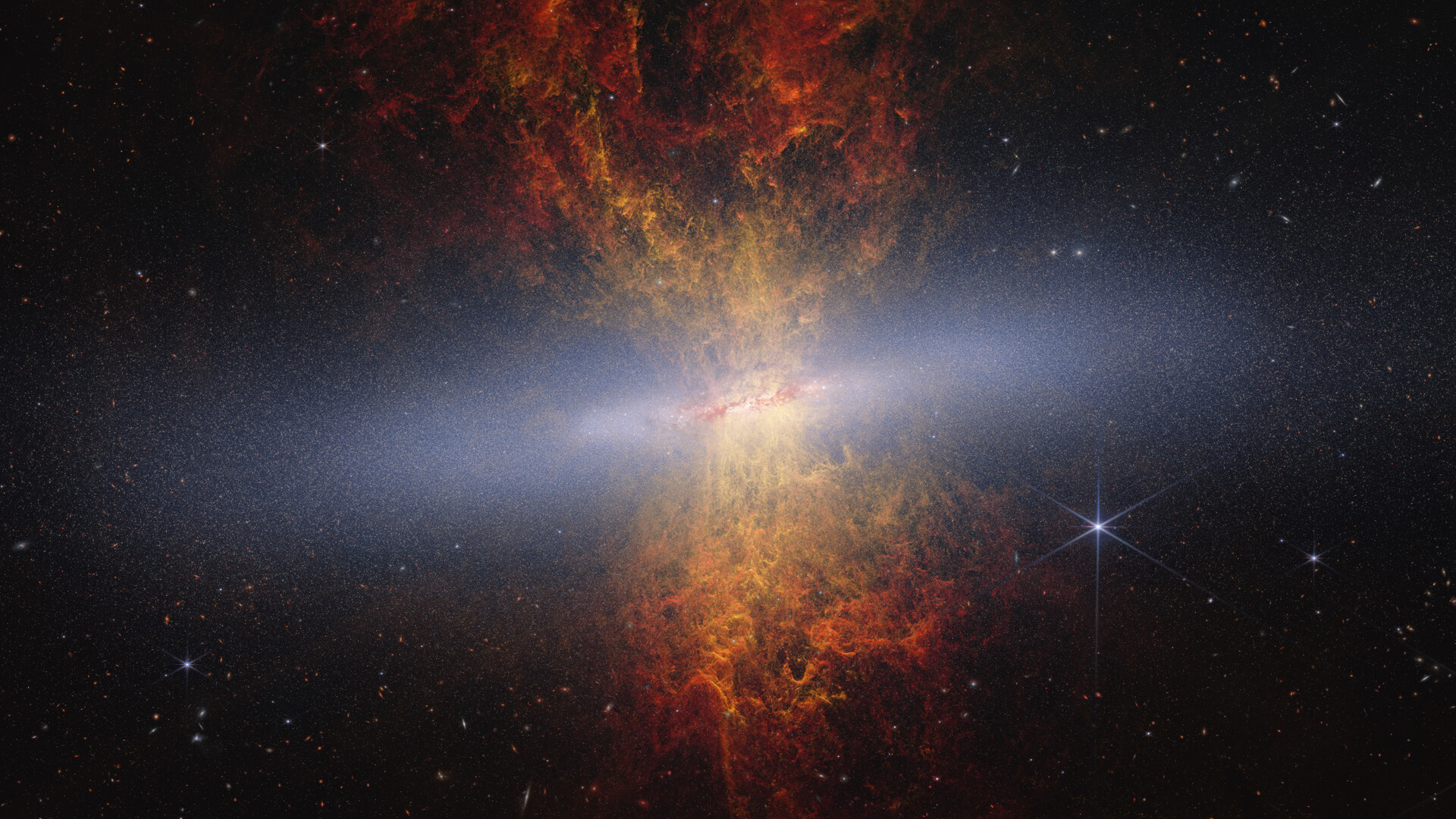
The NASA/ESA/CSA James Webb Space Telescope’s recently observed edge-on starburst galaxy Messier 82 (M82), nicknamed the Cigar Galaxy. Webb’s near-infrared-light view is a snapshot in time, revealing a scene that has been evolving over a couple hundred million years. In near-infrared light, astronomers can see the galaxy’s distended disc structure and millions of individual stars — approximately 16.5 million — for the first time.
Depicted as luminous blue granules, these stars are only a small portion of the total amount astronomers think reside in a galaxy like M82. The extreme star formation occurring within M82, which will eventually cause star formation to cease in the future, is causing bipolar plumes of material to be ejected above and below the galaxy’s disc.
Yellow tendrils of material closest to the galaxy’s disc represent ionised gas, and the orange material farther away depicts small dust grains. These grains are called polycyclic aromatic hydrocarbons and are helpful in tracing material in the space between the galaxy’s stars — also known as the interstellar medium.
Webb’s detailed observation of the galaxy, specifically of the main plane of the disc, is aiding astronomers as they seek to uncover the formation history of M82. The telescope data will also help scientists understand the current processes occurring within the starburst galaxy.
[Image description: Composite image of edge-on spiral starburst galaxy Messier 82 as observed by Webb and Hubble. Hourglass-shaped plumes of gas are shooting outward from above and below a bright blue-white, disc-shaped centre. The plumes are yellow near the galaxy’s bright centre, denoting areas of ionised hydrogen gas as observed by Hubble, and gradually become redder as you move farther away. Messier 82 is set against the black background of space, which has many distant galaxies that appear as small white and orange spirals, ovals, and points of light. Toward the right of Messier 82 is a blue-white star with eight-pointed diffraction spikes that are characteristic of Webb.]
Credit:NASA, ESA, CSA, A. Smercina (STScI), T. Williams (University of Manchester). Image processing: A. Pagan (STScI).
About the Image
| Id: | weic2612a | |
|---|---|---|
| Type: | Observation | |
| Release date: | 23 June 2026, 16:00 | |
| Related releases: | weic2612 | |
| Size: | 15187 x 10238 px | |