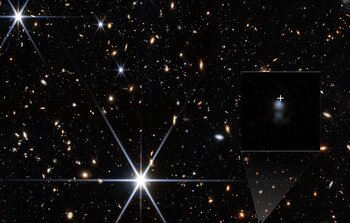
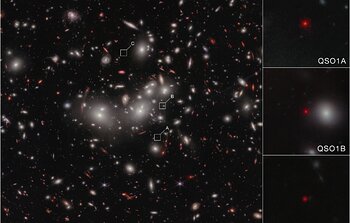
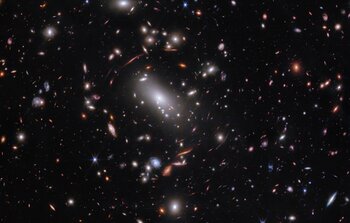
Using the unprecedented imaging and spectroscopic power of the NASA/ESA/CSA James Webb Space Telescope, researchers have mapped the motion and composition of gas orbiting a black hole in the centre of Abell2744-QSO1, a tiny galaxy more than 13 billion light-years away. The results suggest that the 50-million-solar-mass black hole predates its host galaxy, possibly forming within the first second of the Big Bang, and must have been immense from the start.
Read more
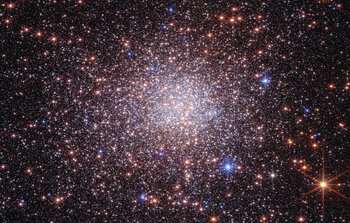
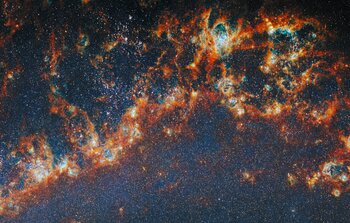
Astronomers using the NASA/ESA/CSA James Webb Space Telescope together with the NASA/ESA Hubble Space Telescope have looked deeply at thousands of young star clusters in four nearby galaxies, studying clusters at different stages of evolution. Their findings show that more massive star clusters emerge more quickly from the clouds they are born in, clearing away gas and filling the galaxy with ultraviolet light. The result gives us a more detailed understanding of star formation in galaxies, as well as how and where planets can form.
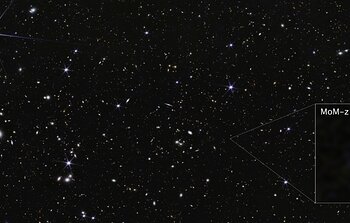
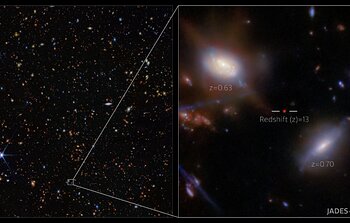
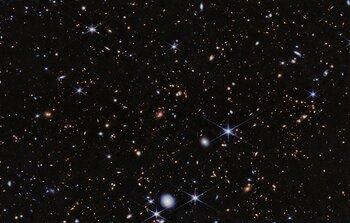
The NASA/ESA/CSA James Webb Space Telescope has topped itself once again, delivering on its promise to push the boundaries of the observable Universe closer to cosmic dawn with the confirmation of a bright galaxy that existed 280 million years after the Big Bang.
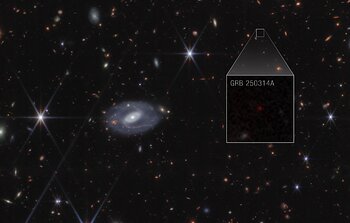
The NASA/ESA/CSA James Webb Space Telescope has confirmed the source of a super-bright flash of light known as a gamma-ray burst, generated by an exploding massive star when the Universe was only 730 million years old. For the first time for such a remote event, the telescope provided a detection of the supernova’s host galaxy. Webb’s quick-turnaround observations verified data taken by telescopes around the world that had been following the gamma-ray burst since its onset, which occurred in mid-March.
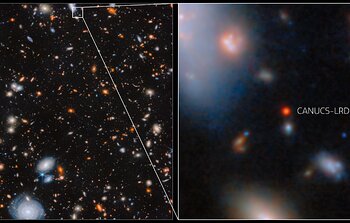
Researchers using the NASA/ESA/CSA James Webb Space Telescope have confirmed an actively growing supermassive black hole within a galaxy just 570 million years after the Big Bang. Part of a class of small, very distant galaxies that have mystified astronomers, CANUCS-LRD-z8.6 represents a vital piece of this puzzle that challenges existing theories about the formation of galaxies and black holes in the early Universe. The discovery connects early black holes with the luminous quasars we observe today.
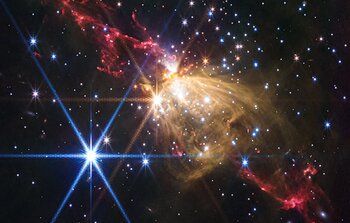
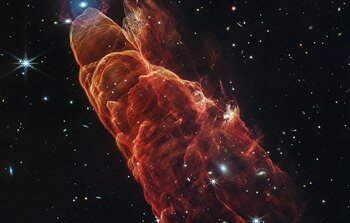
Way out toward the edge of our Milky Way galaxy, a young star that is still forming is sending out a birth announcement to the Universe in the form of a celebratory looking firework. These seething twin jets of hot gasses are blazing across 8 light-years – twice the distance between our Sun and the nearest star system. Superheated gases falling onto the massive star are blasted back into space along the star’s rotational axis and powerful magnetic fields confine the jets to narrow beams. The NASA/ESA/CSA James Webb Space Telescope witnessed the spectacle in infrared light. The jets are plowing into interstellar dust and gas, creating fascinating details captured only by Webb.
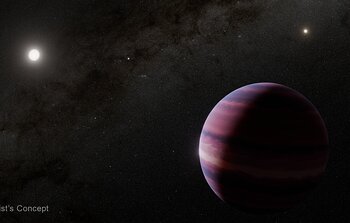
Astronomers using the NASA/ESA/CSA James Webb Space Telescope have found strong evidence of a giant planet orbiting a star in the stellar system closest to our own Sun. At just 4 light-years away from Earth, the Alpha Centauri triple star system has long been a compelling target in the search for worlds beyond our solar system.
To mark its third year of highly productive science, astronomers used the NASA/ESA/CSA James Webb Space Telescope to scratch beyond the surface of the Cat’s Paw Nebula (NGC 6334), a massive, local star-forming region.
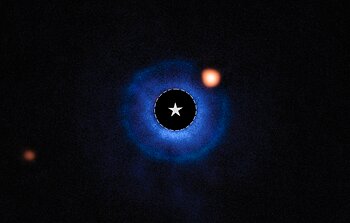
Astronomers using the NASA/ESA/CSA James Webb Space Telescope have captured compelling evidence of a planet with a mass similar to Saturn orbiting the young nearby star TWA 7. If confirmed, this would represent Webb’s first direct image discovery of a planet, and the lightest planet ever seen with this technique.
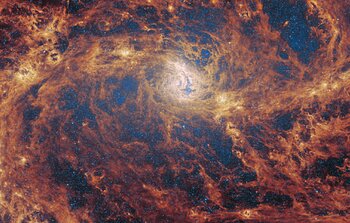
Astronomers using the NASA/ESA/CSA James Webb Space Telescope have discovered evidence that suggests the presence of a long-sought supermassive black hole at the heart of the nearby spiral galaxy Messier 83 (M83). This surprising finding, made possible by Webb’s Mid-Infrared Instrument (MIRI), reveals highly ionised neon gas that could be a telltale signature of an active galactic nucleus (AGN), a growing black hole at the center of a galaxy.
Using the unique infrared sensitivity of the NASA/ESA/CSA James Webb Space Telescope, researchers can examine ancient galaxies to probe secrets of the early universe. Now, an international team of astronomers has identified bright hydrogen emission from a galaxy in an unexpectedly early time in the Universe’s history. The surprise finding is challenging researchers to explain how this light could have pierced the thick fog of neutral hydrogen that filled space at that time.
The NASA/ESA/CSA James Webb Space Telescope has captured a beautiful juxtaposition of the nearby protostellar outflow known as Herbig-Haro 49/50 with a perfectly positioned, more distant spiral galaxy. Due to the close proximity of this Herbig-Haro object to the Earth, this new composite infrared image of the outflow from a young star allows researchers to examine details on small spatial scales like never before. With Webb, we can better understand how the jet activity associated with the formation of young stars can affect their surrounding environment.
For the first time, the NASA/ESA/CSA James Webb Space Telescope has detected and ‘weighed’ a galaxy that not only existed around 600 million years after the Big Bang, but also has a mass that is similar to what our Milky Way galaxy’s mass might have been at the same stage of development. Other galaxies Webb has detected at this period in the history of the Universe are significantly more massive. Nicknamed the Firefly Sparkle, this galaxy is gleaming with star clusters — 10 in all — each of which researchers examined in great detail.
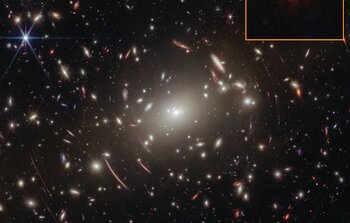
Using the NASA/ESA/CSA James Webb Space Telescope, an international team of astronomers have found new galaxies in the Spiderweb protocluster. Their characteristics shed light on the growth of galaxies in these large cosmic cities, with the finding that gravitational interactions in these dense regions are not as important as previously thought.
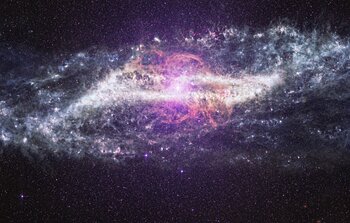
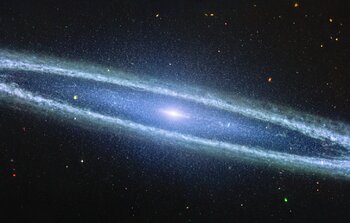
A new mid-infrared image from the NASA/ESA/CSA James Webb Space Telescope features the Sombrero galaxy, also known as Messier 104 (M104). The signature, glowing core seen in visible-light images does not shine, and instead a smooth inner disk is revealed. The sharp resolution of Webb’s MIRI (Mid-Infrared Instrument) also brings into focus details of the galaxy’s outer ring, providing insights into how the dust, an essential building block for astronomical objects in the Universe, is distributed. The galaxy’s outer ring shows intricate clumps in the infrared for the first time.

Stare deeply at these galaxies. They appear as if blood is pumping through the top of a flesh-free face. The long, ghastly ‘stare’ of their searing eye-like cores shines out into the supreme cosmic darkness.
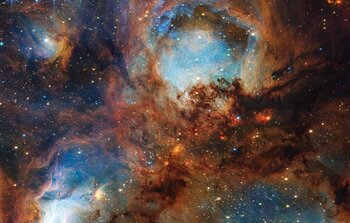
An international team of astronomers has used the NASA/ESA/CSA James Webb Space Telescope to detect the first rich population of brown dwarf candidates outside the Milky Way in the star cluster NGC 602.
Looking deep into the early universe with the NASA/ESA/CSA James Webb Space Telescope, astronomers have found something unprecedented: a galaxy with an odd light signature, which they attribute to its gas outshining its stars.
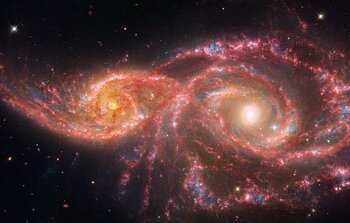
An interaction between an elliptical galaxy and a larger spiral galaxy, collectively known as Arp 107, seems to have given the spiral a happier outlook thanks to the two bright ‘eyes’ and the wide semicircular ‘smile’ that have resulted. This image is a composite, combining observations from Webb’s MIRI (Mid-InfraRed Instrument) and NIRCam (Near-InfraRed Camera).
Within the Milky Way’s outskirts is a firecracker show of star formation. The NASA/ESA/CSA James Webb Space Telescope has examined the fringes of our Milky Way galaxy and Webb’s near- and mid-infrared imaging capabilities have enabled scientists to examine a star-forming area reminiscent of our galaxy during its early stages of formation.