Subscribe to Webb News
Home
News
Press Releases
For Scientists
Newsworthy Results
2026
2025
2024
2023
2022
2021
Announcements
2026
2025
2024
2023
2022
Picture of the Month
2026
2025
2024
2023
2022
Images
All Images
Picture of the Month
Categories
Anniversaries
Exoplanets
First Images
Galaxies
Graphics
Illustrations
Launch
MIRI
Nebulae
NIRCam
NIRISS
NIRSpec
Picture of the Month
Quasars and Black Holes
Solar System
Spacecraft
Spectroscopy
Stars
Videos
All Videos
Video Formats
About
General
Mission Overview
Fact Sheet
Instruments
MIRI
NIRSpec
NIRCam
NIRISS
Sun Shield
Mirrors
Orbit
Spectroscopy with Webb
Webb & Other Space Telescopes
Webb's Scientific Method
Image Processing
Webb and Europe
International Collaboration
Ariane Launcher
ESA/Webb Outreach Team
Science
Other Worlds
The Lifecycle of Stars
The Early Universe
Galaxies Over Time
FAQ
For Scientists
Newsworthy Results
Initiatives
Webb's First Images
Word Bank
Public Resources
Virtual Meeting Backgrounds
ESA Webb Seeing Farther Brochure
Calendars
2025
2024
2023
Newsletters
ESA/Webb Newsletters
ESA/Webb News
ESA/Hubble/Webb Science Newsletter
Science Announcements
Media
Usage of ESA/Webb Images & Videos
Subscribe to the Media Newsletter
Contact
Picture of the Month
Subscribe to receive news from ESA/Webb!
potm2209 — Picture of the Month
Webb’s Icy Instrument Reveals Complex Structures
27 September 2022
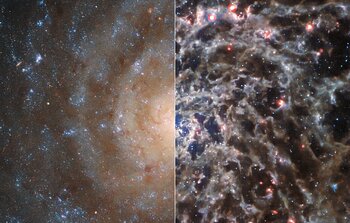
This spectacular image features the spiral galaxy IC 5332, shown here in unprecedented detail thanks to observations from the Mid-InfraRed Instrument (MIRI), which is mounted on the NASA/ESA/CSA James Webb Space Telescope. IC 5332 lies over 29 million light-years from Earth, and has a diameter of roughly 66 000 light-years, making it about a third smaller than the Milky Way. It is notable for being almost perfectly face-on with respect to Earth, allowing us to admire the symmetrical sweep of its spiral arms. MIRI is the only Webb instrument that is sensitive to the mid-infrared region of the electromagnetic spectrum (specifically in the 5 µm – 28 µm wavelength range); Webb’s other instruments all operate in the near-infrared. One of MIRI’s most remarkable features is that it operates 33 °C below the rest of the observatory at the frosty temperature of –266 °C. That means that MIRI operates in an …
Read more
potm2208 — Picture of the Month
Webb Inspects the Heart of the Phantom Galaxy
29 August 2022
This image from the NASA/ESA/CSA James Webb Space Telescope shows the heart of M74, otherwise known as the Phantom Galaxy. Webb’s sharp vision has revealed delicate filaments of gas and dust in the grandiose spiral arms which wind outwards from the centre of this image. A lack of gas in the nuclear region also provides an unobscured view of the nuclear star cluster at the galaxy's centre. M74 is a particular class of spiral galaxy known as a ‘grand design spiral’, meaning that its spiral arms are prominent and well-defined, unlike the patchy and ragged structure seen in some spiral galaxies. The Phantom Galaxy is around 32 million light-years away from Earth in the constellation Pisces, and lies almost face-on to Earth. This, coupled with its well-defined spiral arms, makes it a favourite target for astronomers studying the origin and structure of galactic spirals. Webb gazed into M74 with its …
Read more
potm2207 — Picture of the Month
Stephan’s Quintet (MIRI Imaging)
12 July 2022
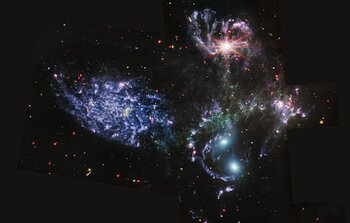
Webb's Mid-InfraRed Instrument (MIRI) shows never-before-seen details of Stephan’s Quintet, a visual grouping of five galaxies, in this image. MIRI pierced through dust-enshrouded regions to reveal huge shock waves and tidal tails, gas and stars stripped from the outer regions of the galaxies by interactions. It also unveiled hidden areas of star formation. The new information from MIRI provides invaluable insights into how galactic interactions may have driven galaxy evolution in the early universe. This image was released as part of the first set of images from the NASA/ESA/CSA James Webb Space Telescope on 12 July 2022 (for a full array of Webb’s first images and spectra, including downloadable files, please visit this page). This image contains one more MIRI filter than was used in the NIRCam-MIRI composite picture. The image processing specialists at the Space Telescope Science Institute in Baltimore opted to use all three MIRI filters and the …
Read more
potm2206 — Picture of the Month
Fine Guidance Sensor Test Image
27 June 2022
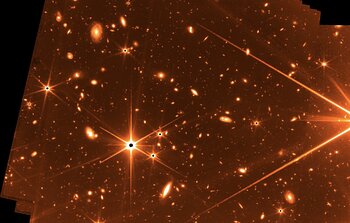
Webb’s Fine Guidance Sensor (FGS) – developed by the Canadian Space Agency – has captured a special view of stars and galaxies that provides a tantalising glimpse at what the telescope’s science instruments will reveal in the coming weeks, months, and years. The FGS has always been capable of capturing imagery, but its primary purpose is to enable accurate science measurements and imaging with precision pointing. When it does capture imagery, the imagery is typically not kept: Given the limited communications bandwidth between L2 and Earth, Webb only sends data from up to two science instruments at a time. But during a week-long stability test in May, it occurred to the team that they could keep the imagery that was being captured because there was available data transfer bandwidth. The resulting engineering test image has some rough-around-the-edges qualities to it. It was not optimised to be a science observation; rather, …
Read more
potm2205 — Picture of the Month
MIRI and Spitzer Comparison Image
9 May 2022
This MIRI test image (at 7.7 microns) shows part of the Large Magellanic Cloud. This small satellite galaxy of the Milky Way provided a dense star field to test Webb’s performance. Here, a close-up of the MIRI image is compared to a past image of the same target taken with NASA’s Spitzer Space Telescope’s Infrared Array Camera (at 8.0 microns). The retired Spitzer was the first observatory to provide high-resolution images of the near- and mid-infrared Universe. Webb, by virtue of its significantly larger primary mirror and improved detectors, will allow us to see the infrared sky with improved clarity, enabling even more discoveries. For example, Webb’s MIRI image shows the interstellar gas in unprecedented detail. Here, you can see the emission from ‘polycyclic aromatic hydrocarbons’ – molecules of carbon and hydrogen that play an important role in the thermal balance and chemistry of interstellar gas. When Webb is ready …
Read more
potm2204 — Picture of the Month
Webb in Full Focus
28 April 2022
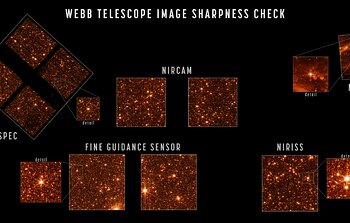
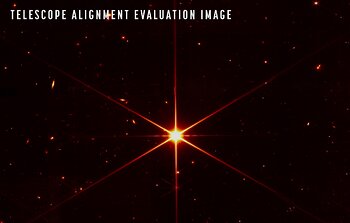
Alignment of the NASA/ESA/CSA James Webb Space Telescope is now complete. After full review, the observatory has been confirmed to be capable of capturing crisp, well-focused images with each of its four powerful onboard science instruments. Upon completing the seventh and final stage of telescope alignment, the team held a set of key decision meetings and unanimously agreed that Webb is ready to move forward into its next and final series of preparations, known as science instrument commissioning. This process of setting up and testing the instruments will take about two months before scientific operations begin in the summer. The alignment of the telescope across all of Webb’s instruments can be seen in a series of images that captures the observatory’s full field of view. Engineering images of sharply focused stars in the field of view of each instrument demonstrate that the telescope is fully aligned and in focus. For …
Read more
potm2203 — Picture of the Month
Webb's First Image of Focused Star
16 March 2022
On 11 March 2022, the NASA/ESA/CSA James Webb Space Telescope (Webb) team completed the stage of mirror alignment known as "fine phasing". Although there are months to go before Webb ultimately delivers its new view of the cosmos, achieving this milestone means the team is confident that Webb’s first-of-its-kind optical system is working as well as possible. At this key stage in the commissioning of Webb’s Optical Telescope Element, every optical parameter that has been checked and tested is performing at, or above, expectations. The team also found no critical issues and no measurable contamination or blockages to Webb’s optical path: the observatory is able to successfully gather light from distant objects and deliver it to its instruments without issue. At this stage of Webb’s mirror alignment, each of the primary mirror segments has been adjusted to produce one unified image of the same star using only Webb’s primary imager, …
Read more
potm2202 — Picture of the Month
Photons Received
11 February 2022
The NASA/ESA/CSA James Webb Space Telescope is nearing completion of the first phase of the months-long process of aligning the observatory’s primary mirror using the Near Infrared Camera (NIRCam) instrument. The team’s challenge was twofold: confirm that NIRCam was ready to collect light from celestial objects, and then identify starlight from the same star in each of the 18 primary mirror segments. The result is an image mosaic of 18 randomly organised dots of starlight, the product of Webb’s unaligned mirror segments all reflecting light from the same star back at Webb’s secondary mirror and into NIRCam’s detectors. What looks like a simple image of blurry starlight now becomes the foundation to align and focus the telescope in order for Webb to deliver unprecedented views of the universe this summer. Over the next month or so, the team will gradually adjust the mirror segments until the 18 images become a …
Read more
potm2201 — Picture of the Month
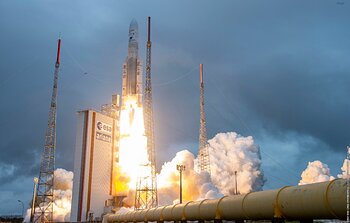
Webb Liftoff on Ariane 5
3 January 2022
The NASA/ESA/CSA James Webb Space Telescope lifted off on an Ariane 5 rocket from Europe’s Spaceport in French Guiana, at 13:20 CET on 25 December on its exciting mission to unlock the secrets of the Universe. Following launch and separation from the rocket, Webb’s mission operations centre in Baltimore, USA confirmed Webb deployed its solar array and is in good condition, marking the launch a success. In the coming month, Webb, an international partnership between NASA, ESA and the Canadian Space Agency (CSA), will travel to its destination: the second Lagrange point (L2), where it will study the Universe in infrared.
Read more
Showing 41 to 49 of 49
1
2
3
Previous
Usage of ESA/Hubble/Webb Images and Videos
Are you a journalist? Subscribe to the ESA/Hubble/Webb Media Newsletter.